A Day in the Life: Brazil Election Day
One woman. One journey. One vote.
A Sunday in October
It is raining in São Paulo, and we are travelling in an Uber towards Perus, where a woman is going to cast her vote in the second round of Brazil’s presidential election. English and American pop music from the 1980s plays through the car speakers. I have brought my camera, although I have not set out to photograph a political rally or a crowd. I want to see what happens when one person undertakes an ordinary journey for a specific civic purpose.
Election days are familiar photographic territory. There are the queues, the flags, the occasional argument, the politicians surrounded by microphones and the supporters waiting for a result. Such photographs have a place in news coverage. But they also leave much of the day outside the frame. Most voters do not arrive surrounded by an audience. They have to get to the polling station, fit the journey around other obligations and return to the rest of their lives afterwards.
For this woman, the journey includes Perus, a neighbourhood to which her family has been connected for more than fifty years. We are going to a family home before travelling onwards to vote. It is not a direct journey from one front door to a ballot box. Her mother votes at one polling place; later, her father, sister and the woman I am following vote at another. This difference will become clearer as the day proceeds.
I am interested in what my photographs will actually establish. A person travelling in an Uber could be on almost any errand. The circumstances of the day give the images their subject, but a camera cannot automatically turn every expression or gesture into evidence of political feeling. There is a difference between recording what I saw and explaining what I assume it meant.
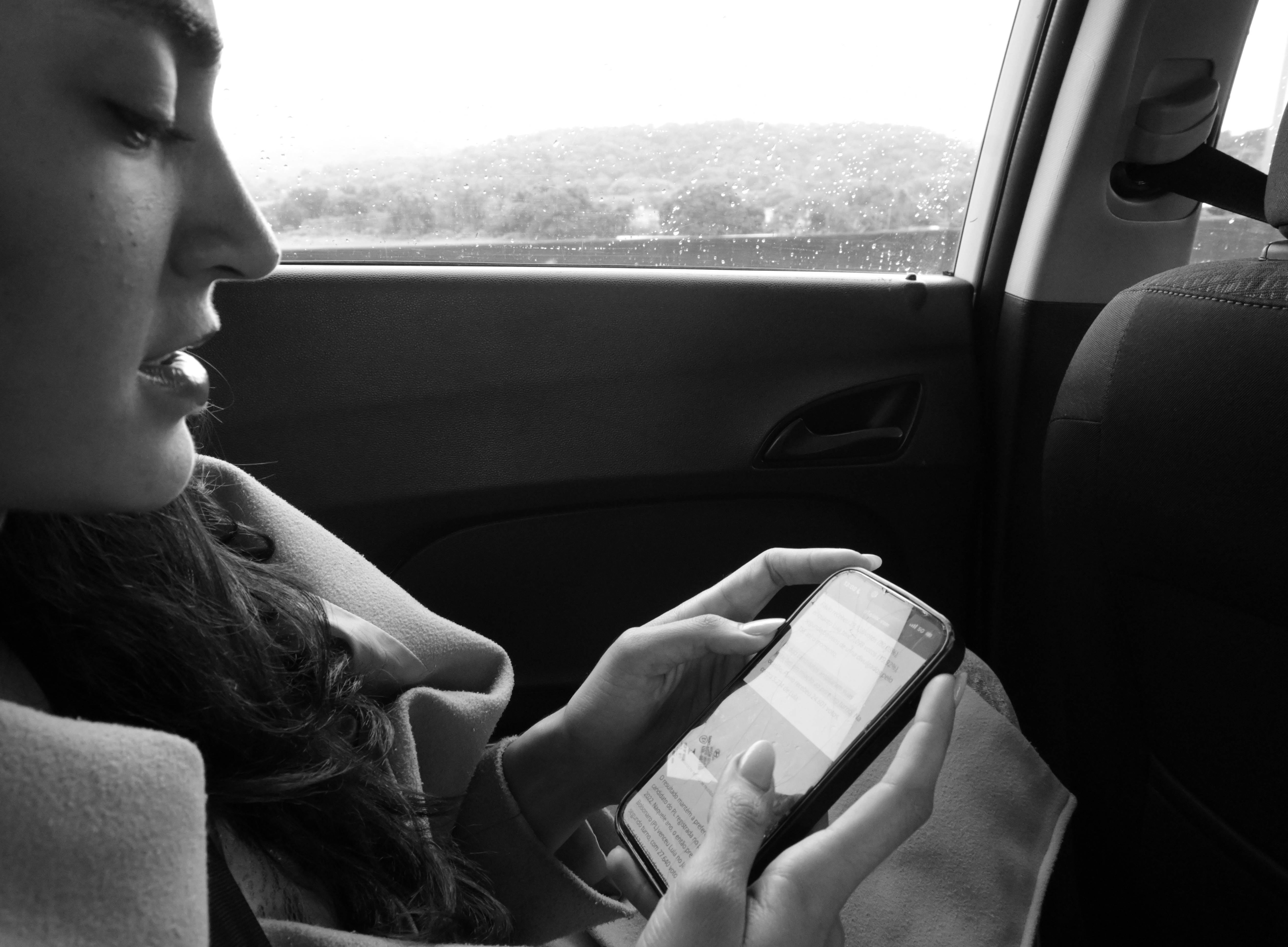
Through the window
The rain is useful photographically, although not necessarily for the people travelling through it. Water on the window alters the view of the city. Buildings lose definition, passing vehicles appear through irregular patches of glass, and reflections interrupt the view outside. These are effects a photographer might deliberately seek, but today they belong to the weather. I have no reason to turn rain into a statement about the political mood.
Inside the Uber, the music continues. Pop songs from another decade seem a slightly unexpected accompaniment to an election journey, perhaps because I have come prepared to notice signs of the occasion. The driver’s playlist is under no obligation to reflect national events. I cannot reproduce music in a still photograph, however much it forms part of the hours I will remember. That is one reason for writing alongside the photographs: there are things heard and experienced which cannot be recovered from the image alone.
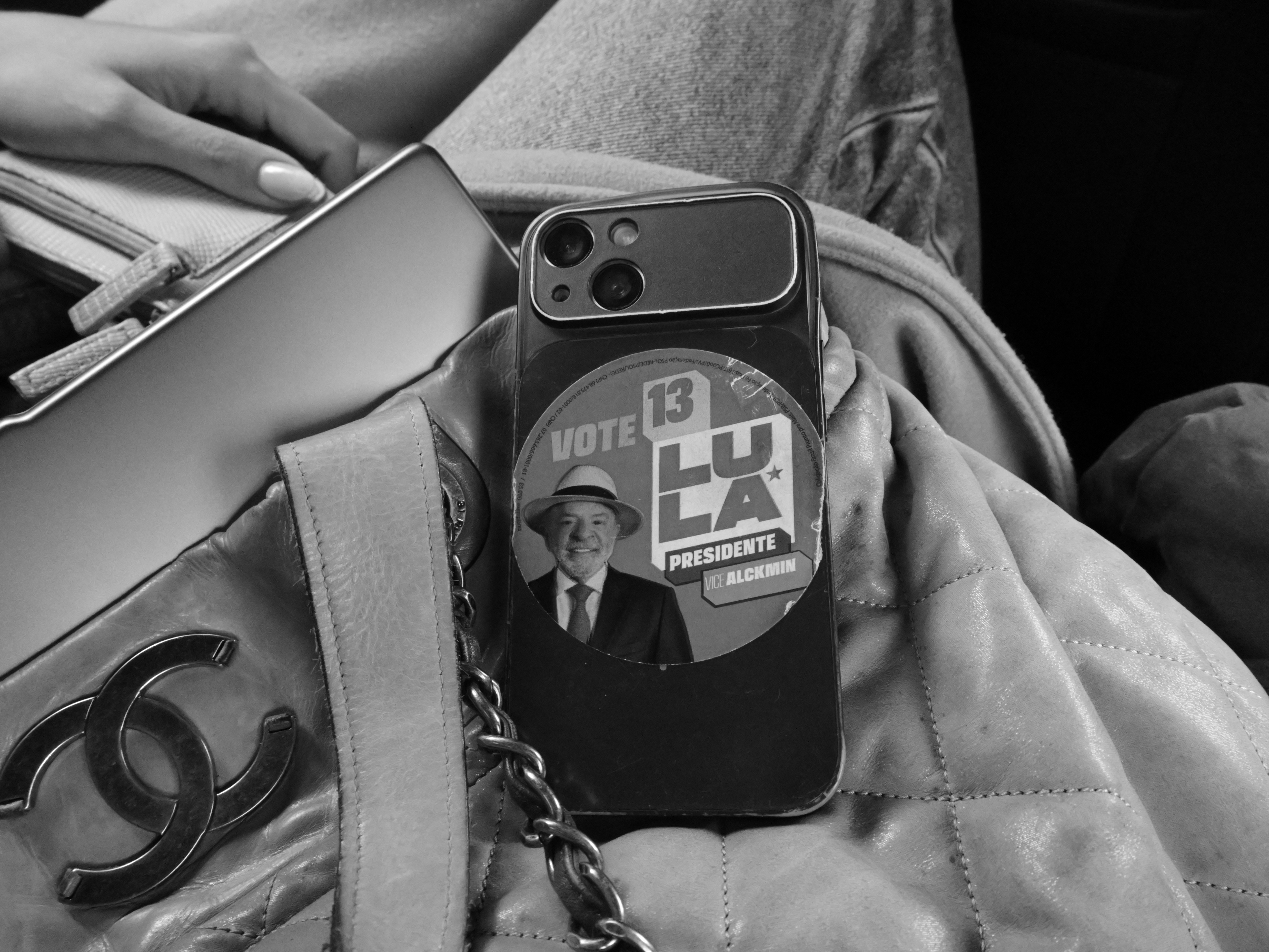
At some point, the driver asks the woman whether she is voting for Bolsonaro. She turns her phone so that he can see the Lula sticker on the back. The question, and the way she answers it, catch my attention. It is an actual exchange rather than a political intention I am trying to infer from an object.
Growing up in England, I knew the familiar advice not to discuss politics or money, particularly with people one scarcely knew. Whether everyone followed it is another matter. Here, a driver has asked a passenger about a political choice, and she has answered by displaying an image. The conversation appears to be part of an ordinary journey. I notice it partly because it crosses a boundary I recognise from my own upbringing.
One conversation does not allow me to describe Brazilian attitudes to political discussion in general. The driver might be curious, conversational or signalling something himself. I do not know. Her sticker is visible, but it cannot explain the whole of her political thinking either. It has, however, performed a function that a photograph of the phone alone would not disclose: it has become her reply.
She also carries the voting receipt from the first round. It is a small administrative record, the kind of paper that can be misplaced among the contents of a bag or wallet. Its physical modesty interests me. The scale of an election is usually described through figures, institutions and geographical maps, yet participation can leave an individual with a narrow strip of paper. The document confirms a procedure without recording a private choice.
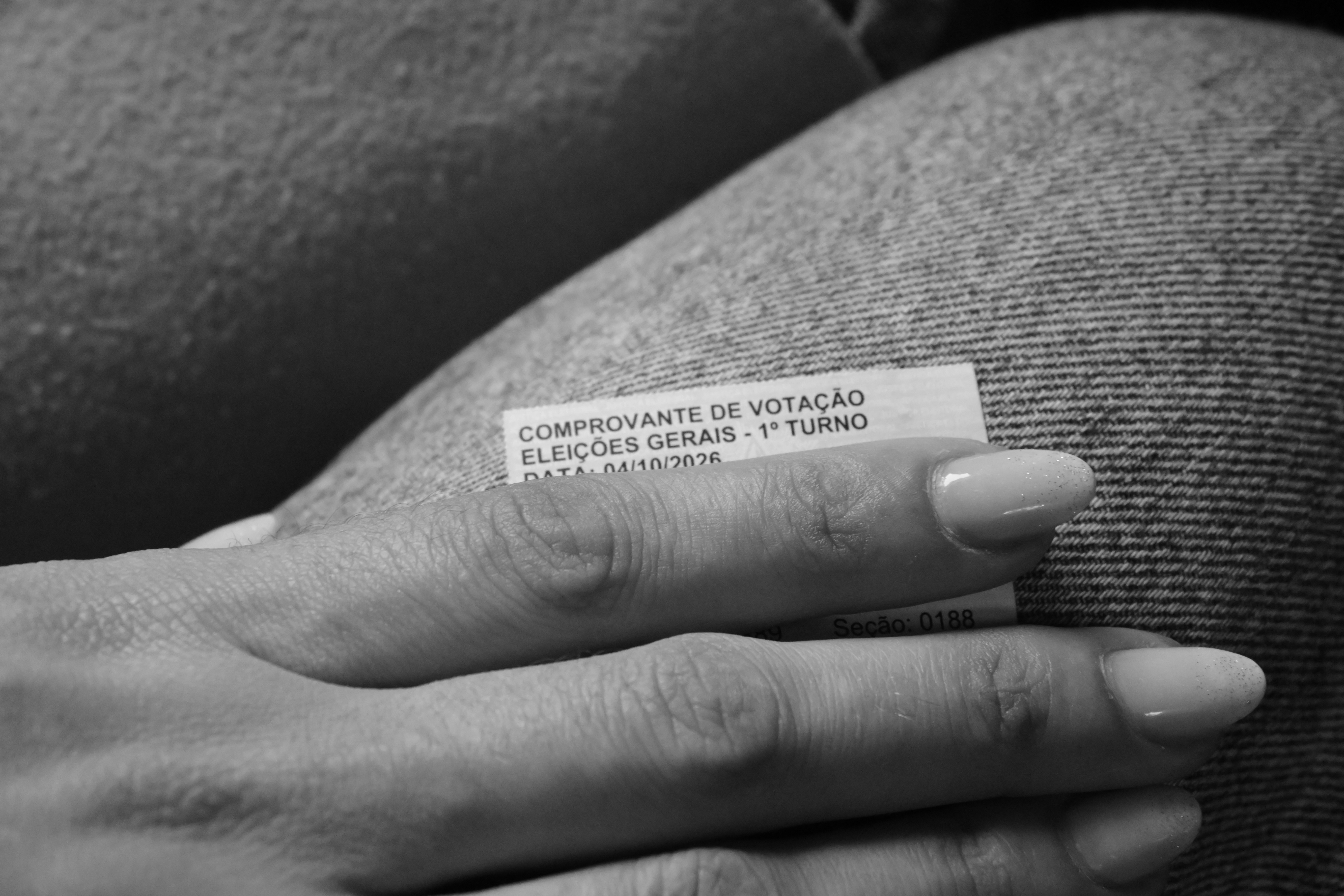
The two objects on or near her person do different things. The sticker is a voluntary public association with a political figure. The receipt is an official confirmation of participation. Neither tells us how she voted in the first round. I can record them as evidence of their presence in the journey without asking them to explain the whole person.
A car ahead of us carries an image of Flavio Bolsonaro. After the driver’s question, I am especially alert to it. Earlier I was looking at Lula’s face on the back of a phone; now another political image is displayed on a vehicle in traffic. The two are part of the same road journey, with no exchange between the people carrying them and no evidence of a confrontation. We are simply sharing the road.
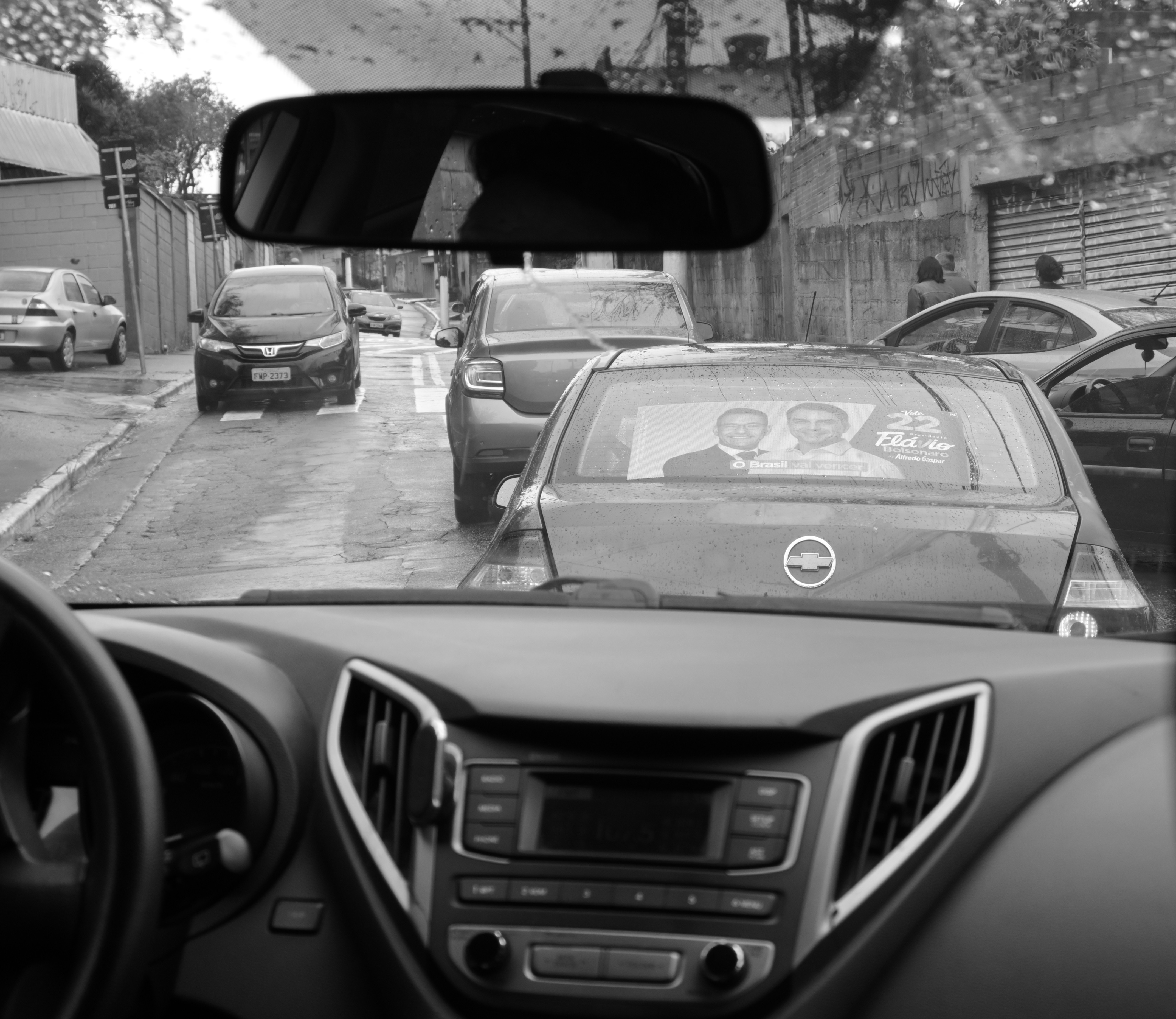
I could describe the two images as evidence of a divided country, but that would reach considerably beyond what the photographs establish. I do not know who placed the Bolsonaro image on the car or why. The picture records its presence in front of us. The political associations are apparent, and I do not need to manufacture an incident to make them more dramatic.
A little further along we pass a polling place where two police officers stand in the rain. I photograph them through the Uber window, holding focus on the drops and streaks of water close to me rather than the figures outside. The officers remain recognisable but blurred, seen from a passing car instead of from a position in the street.
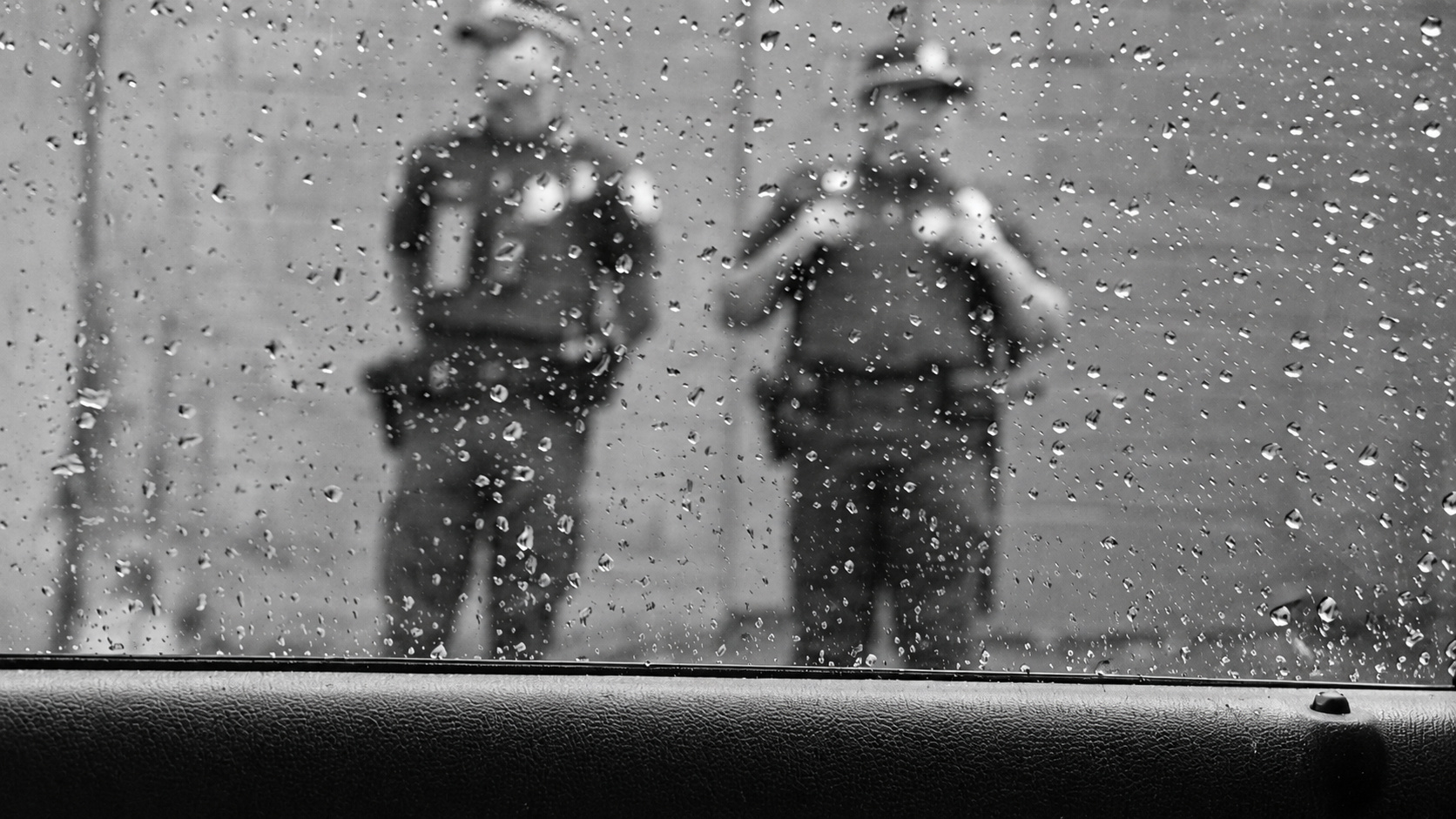
The photograph keeps an important limitation visible. I did not stand beside these officers, speak to them or observe what they were doing for any length of time. Their presence alone tells me nothing about whether any disturbance had occurred. It is tempting to use a uniform as a ready-made sign of tension, particularly on election day, but I cannot support that reading from this brief encounter. The water is sharp. The officers are not. Both belong to the photograph.
A Family home in Perus
Perus lies towards the northwestern edge of São Paulo, away from the districts that dominate the familiar international image of the city. It has its own industrial and labour history, including the former cement factory and the long struggle associated with its workers. That history matters to the district, but it would be a mistake to use it to explain a family’s political convictions without further evidence.
Her mother and father have been in Perus for more than fifty years. That changes the meaning of our destination. I had initially thought of the district as the place where she needed to vote. It is also somewhere her parents have made a life, and where her sister and other relatives are part of the day. The election lasts one Sunday. The family’s connection to the neighbourhood extends back across decades.
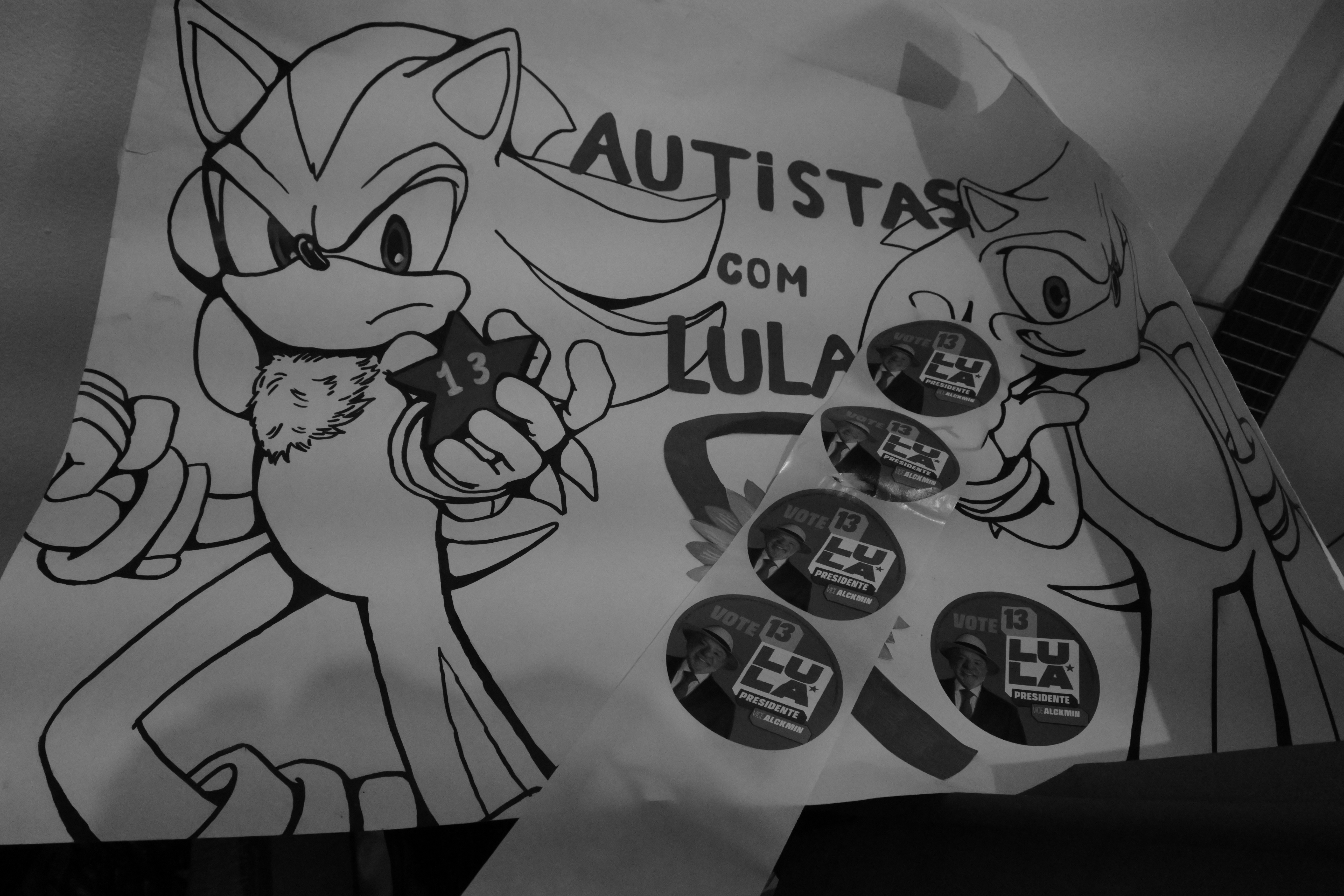
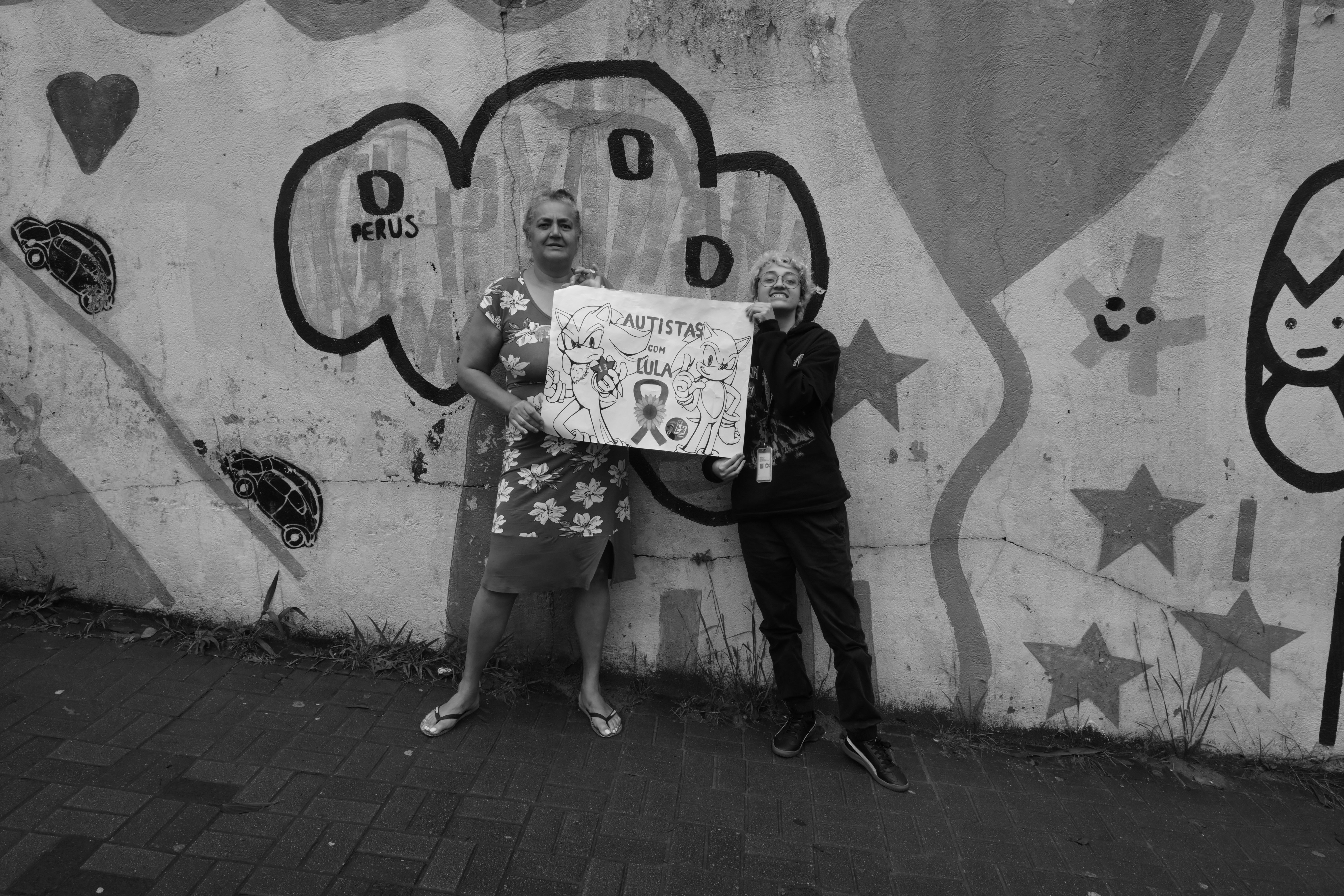
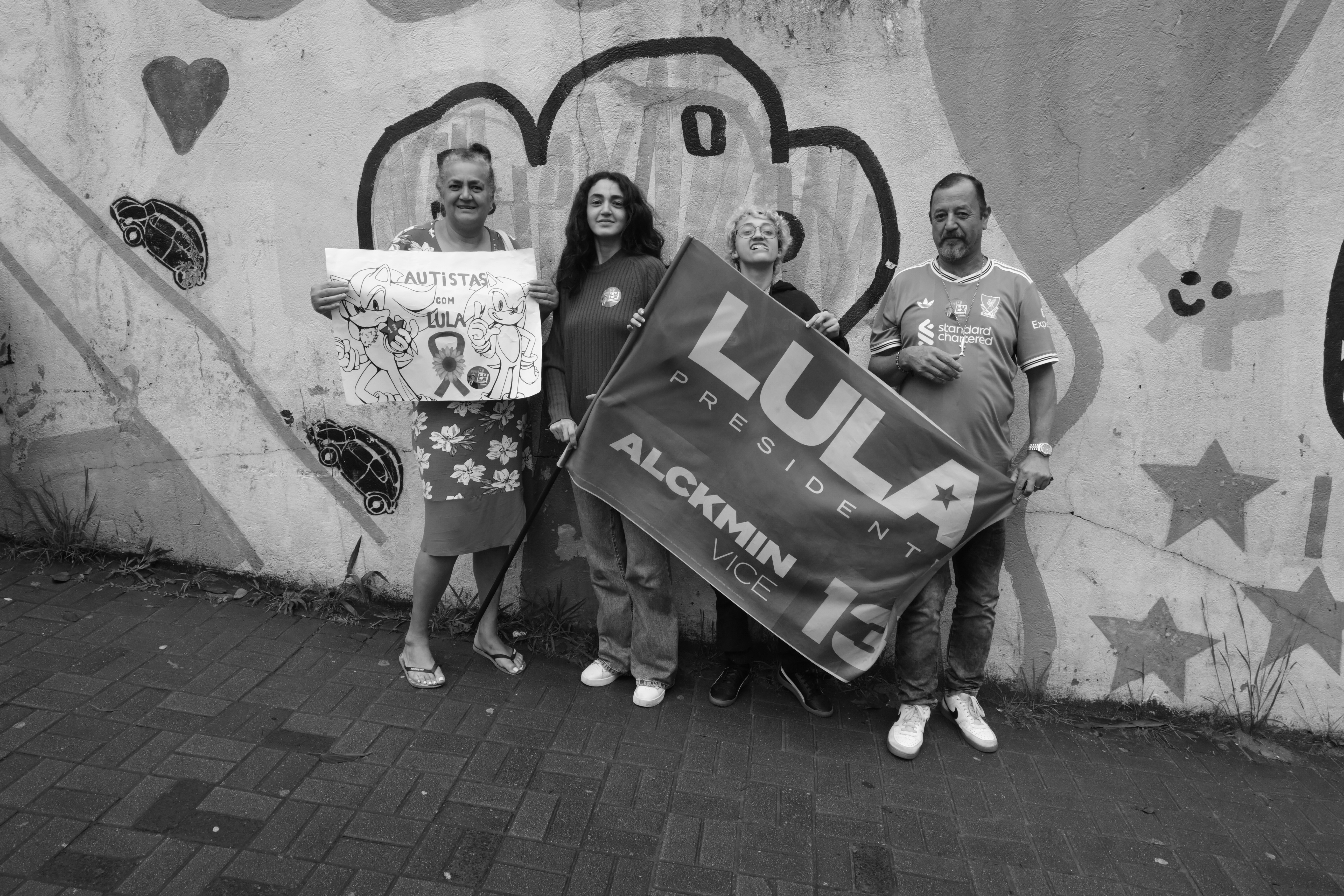
Inside the house I photograph a homemade poster made by her sister. It combines support for Lula with a message concerning autism. The poster is not a professionally produced campaign display; someone in this family has made it. I can identify its author, which gives the photograph a different context from the political stickers seen on the road. I should not assume what prompted her to make it, or how she would explain it in her own words, but the time and work involved are visible in the object.
Lunch is lasagna and rice. Three of us eat together at the family house: the woman, her father and me. It is a straightforward meal, and I did not photograph it. Nothing in the photographs can tell a viewer what was served, who sat down or how the meal fitted between the day’s other arrangements. These are details the written account can preserve without inventing a visual counterpart.
I had set out to follow a woman to vote, and it would have been easy to treat lunch as an interval in the assignment. Yet this is how the day actually happens. People still eat, spend time with family and move between familiar obligations. A national event does not remove the ordinary structure of a Sunday. Whether the family considered lunch noteworthy is another question. They may simply have been having lunch.
The First polling place
Her mother votes at the first polling place. We wait outside. The family’s arrangements are already more complicated than my original idea of one journey to one polling station. Different members have different assigned places, and each vote requires a separate practical visit.
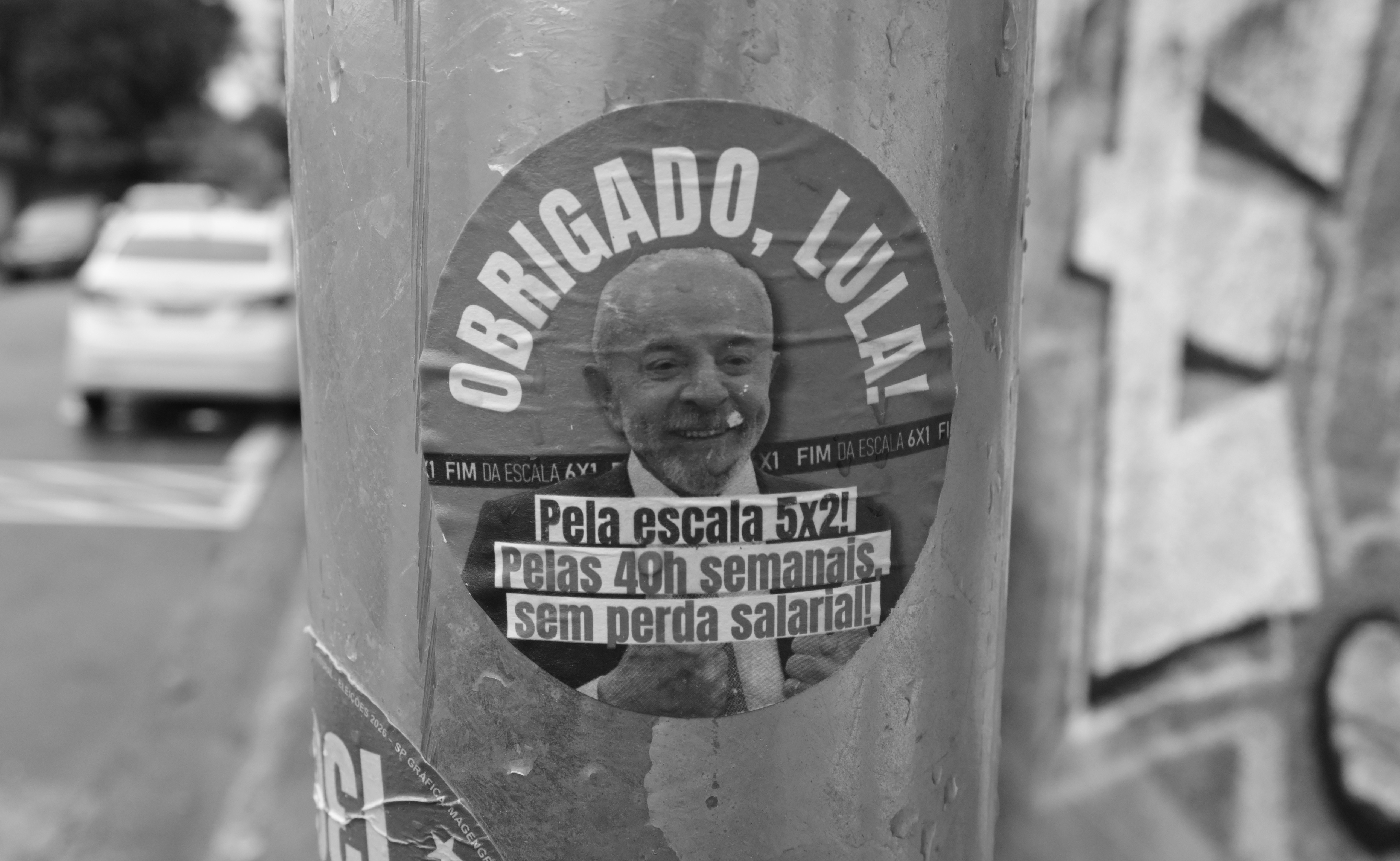
Outside the first location, I photograph a weathered Lula sticker. It has become part of the street, stuck to a post with the everyday road environment beyond it. Unlike the poster in the family home, I have no knowledge of the person who placed this one there. I know what it displays, where I found it and that it was still visible on election day.
There are also photographs of family members. The woman stands beside her blonde-haired sister. Knowing who they are makes a substantial difference to the caption. Without that information, the picture would be a portrait of two women, perhaps interesting in itself but disconnected from the half-century of family history described in the text. I do not want to pretend that kinship can always be read from appearance.
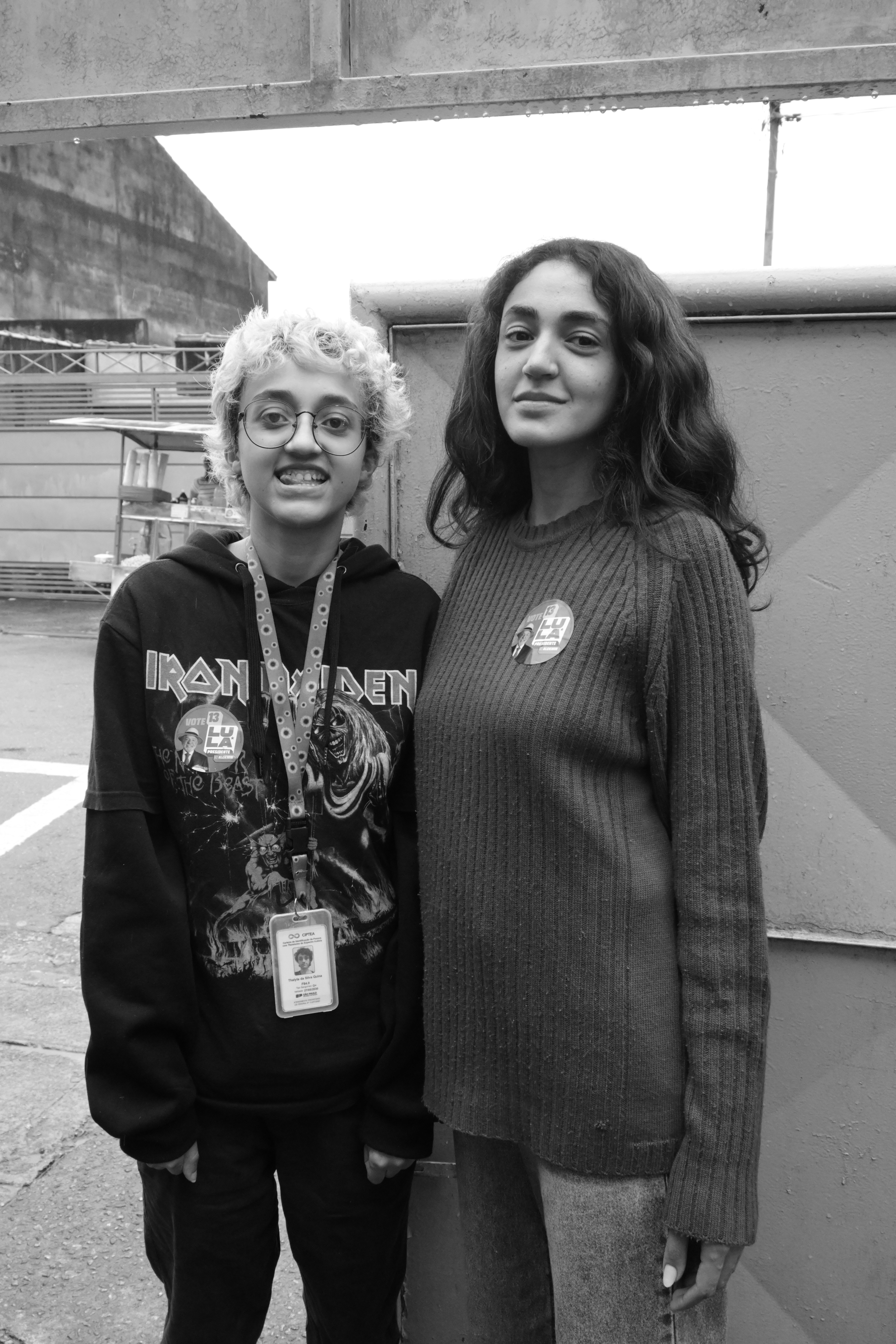
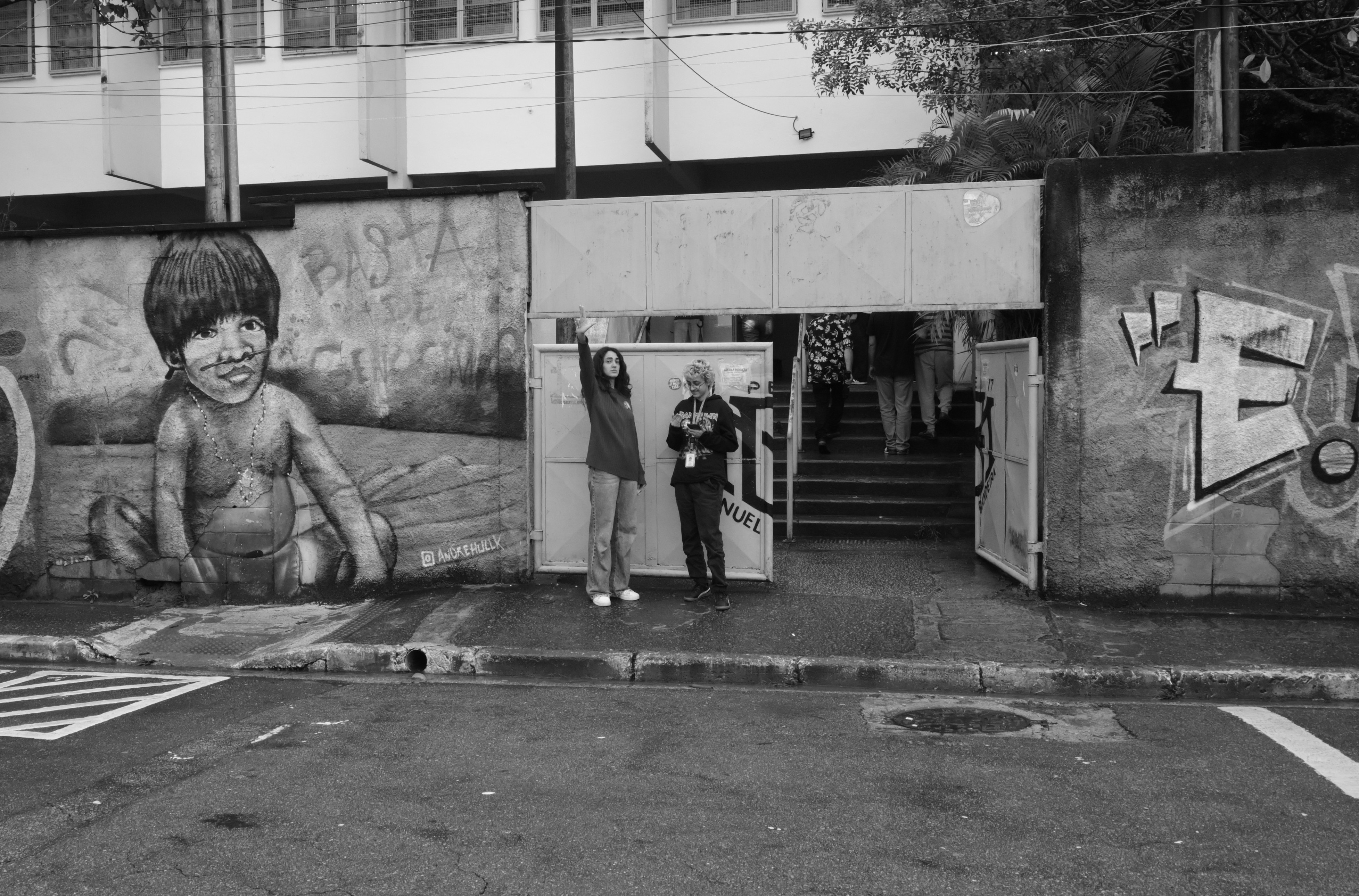
The surroundings of the school introduce another scale. Buildings, entrances and painted walls are ordinary features of a neighbourhood; on this Sunday they have become part of an electoral route. I photograph the entrance to establish where the family is, rather than search in every frame for a dramatic sign of politics.
While I am taking pictures around the first polling place, one police officer notices my camera and offers to pose. I accept. The resulting photograph is different from the two blurred officers taken through the Uber window. In the earlier image, I was observing people from a moving car who had no apparent awareness of being photographed. Here, an officer chooses to participate.
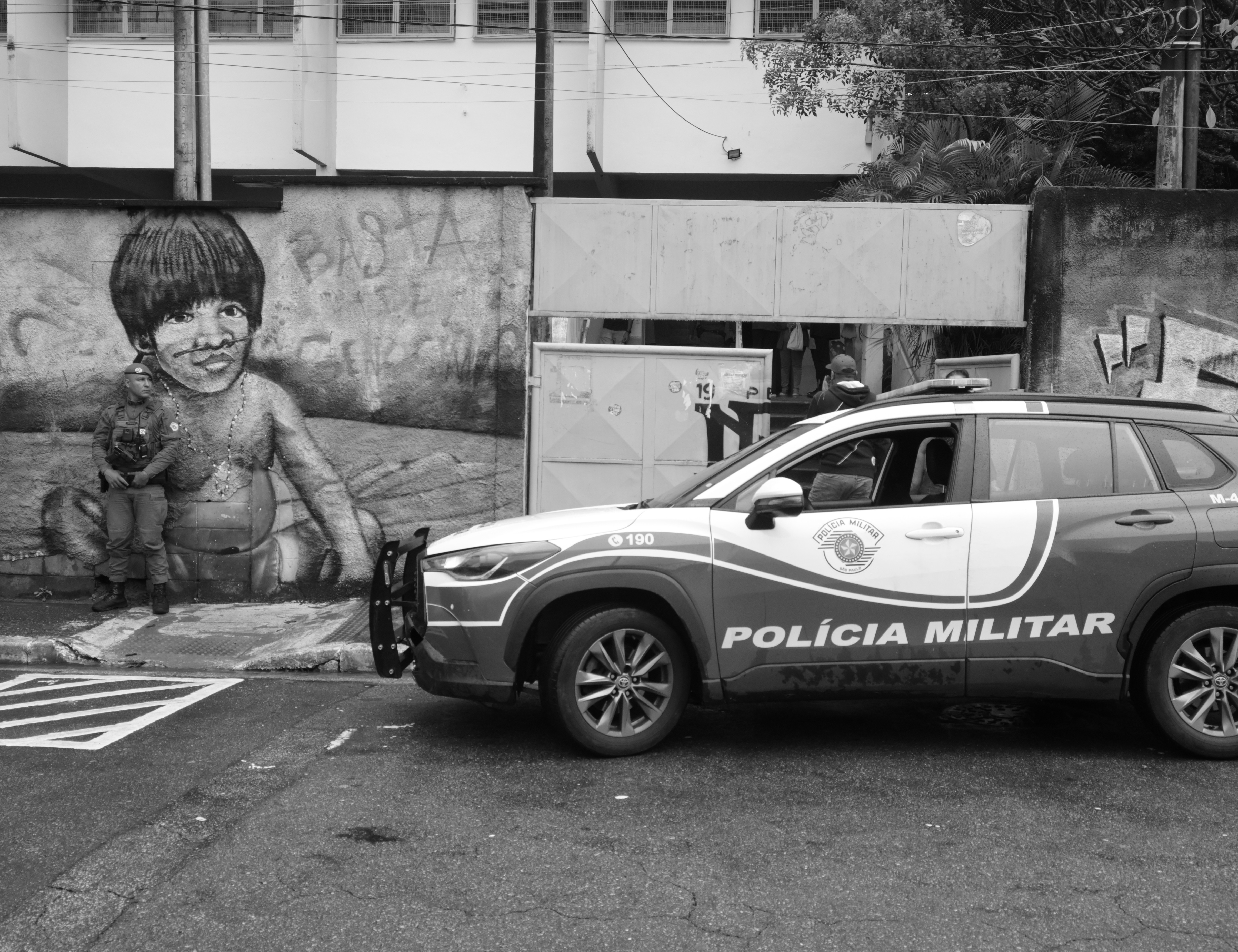
This changes the relationship between the camera and its subject. It would be misleading to present the photograph as a moment caught without the officer’s knowledge. The offer is part of what happened. A cooperative portrait can still belong in a documentary account, provided we understand how it was made. I had come to observe election day, but the people around me were beginning to affect the photographs I made.
The woman’s mother and sister appear together in another picture, her mother on the left and sister on the right. Later photographs include family members holding political material. Their relationships matter because they were there as part of the same day, not merely as representatives of a party.
The Second Polling Place
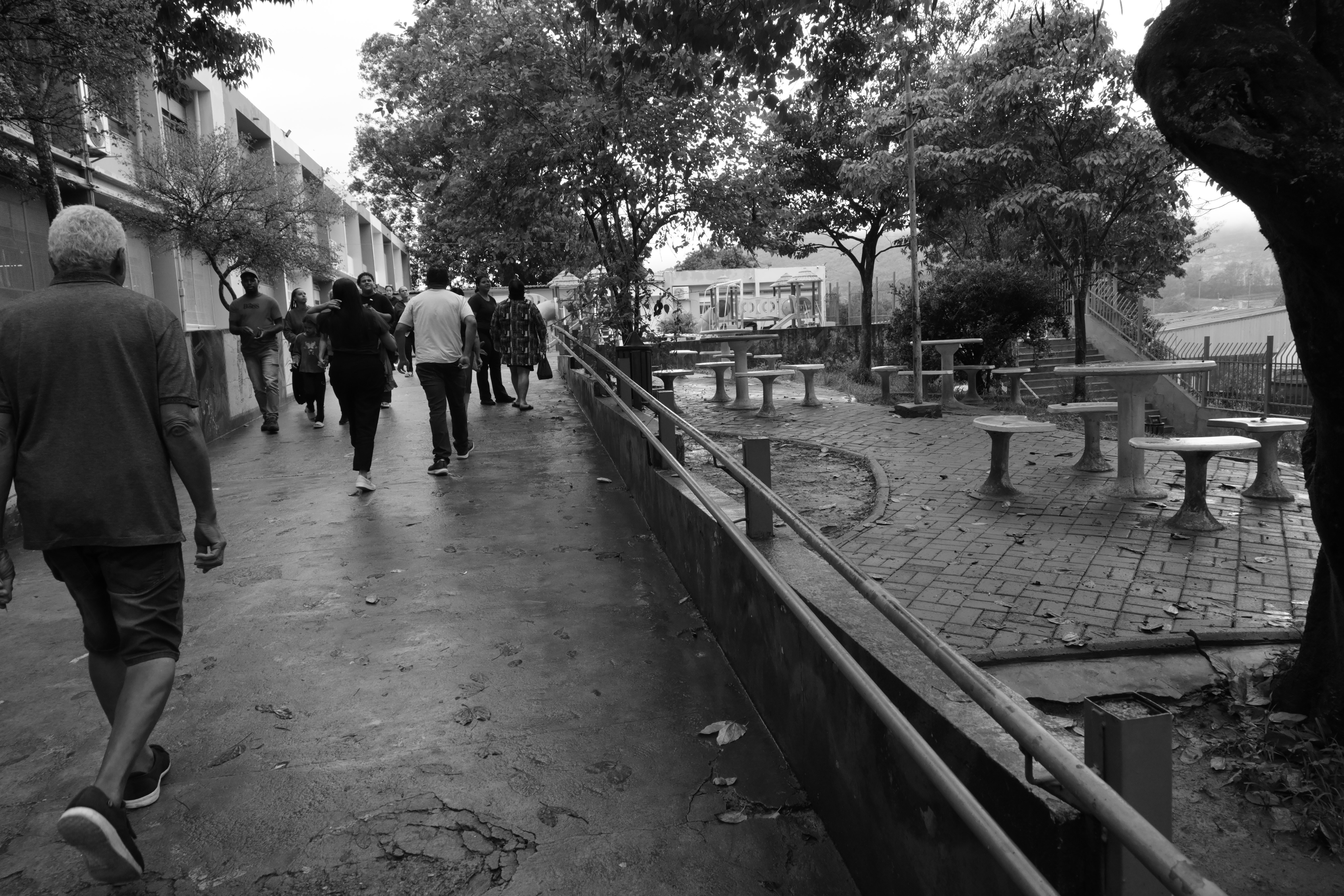
The second polling place begins with another journey. Here the woman I am following, her father and sister are registered to vote. The rain has not vanished from the record; wet paths and the school grounds continue the physical conditions established at the beginning of the day. I can move the narrative to this location through the photographs without pretending every transition was dramatic.
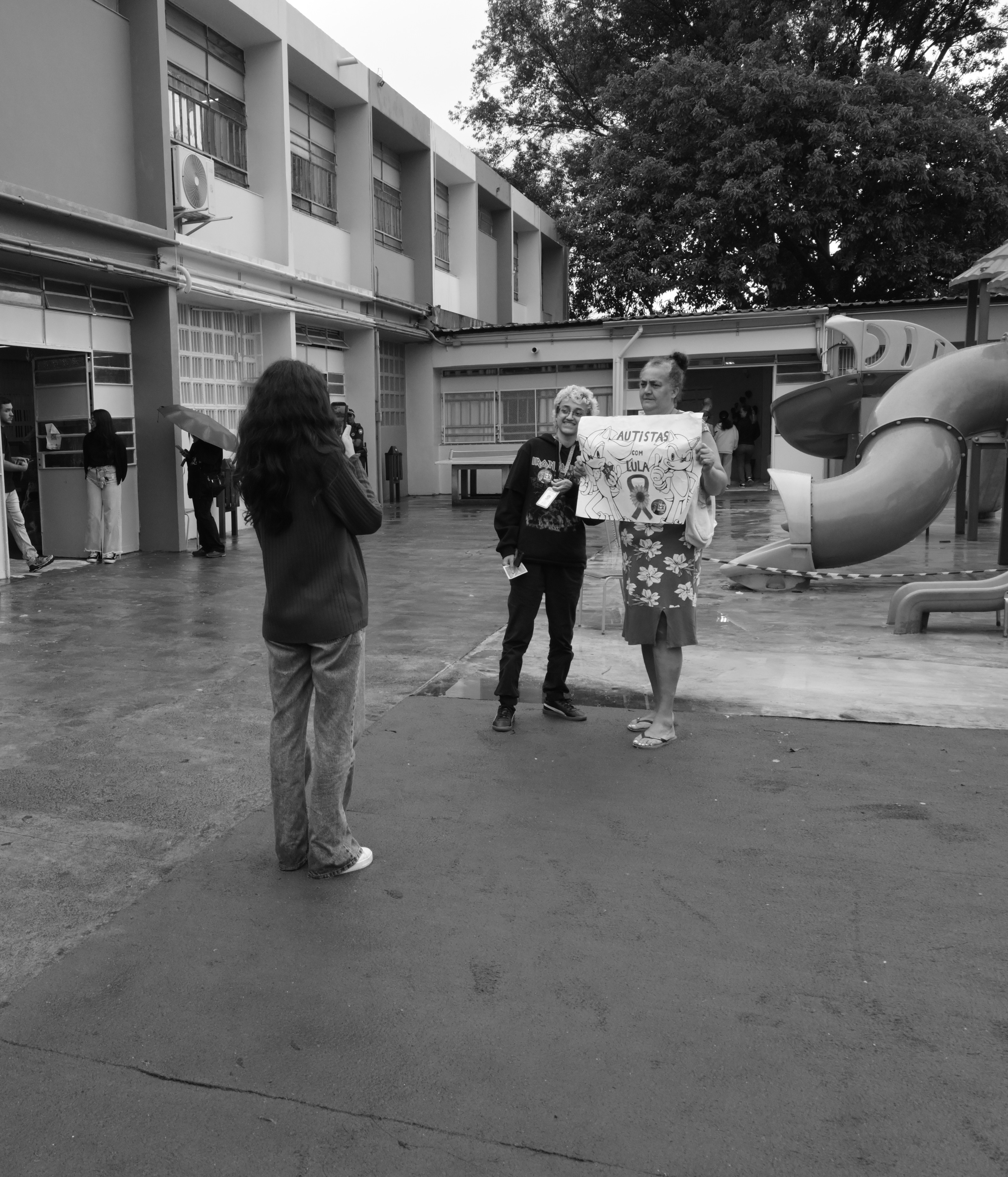
The woman takes out her own camera and photographs her mother and sister with the homemade banner. For a moment I am photographing someone photographing her family. This interests me more than a simple reversal of roles, because we are recording the same occasion for potentially different reasons. I am constructing a documentary essay. She is recording people she knows. Neither photograph needs to stand in for the other.
Around the entrance, the location remains a school as well as a place of voting. The people, walls and open spaces belong to a building with an ordinary purpose outside election day. Their presence prevents the photographs from becoming only a collection of political signs. The task of voting takes place in rooms that have other uses for most of the year.
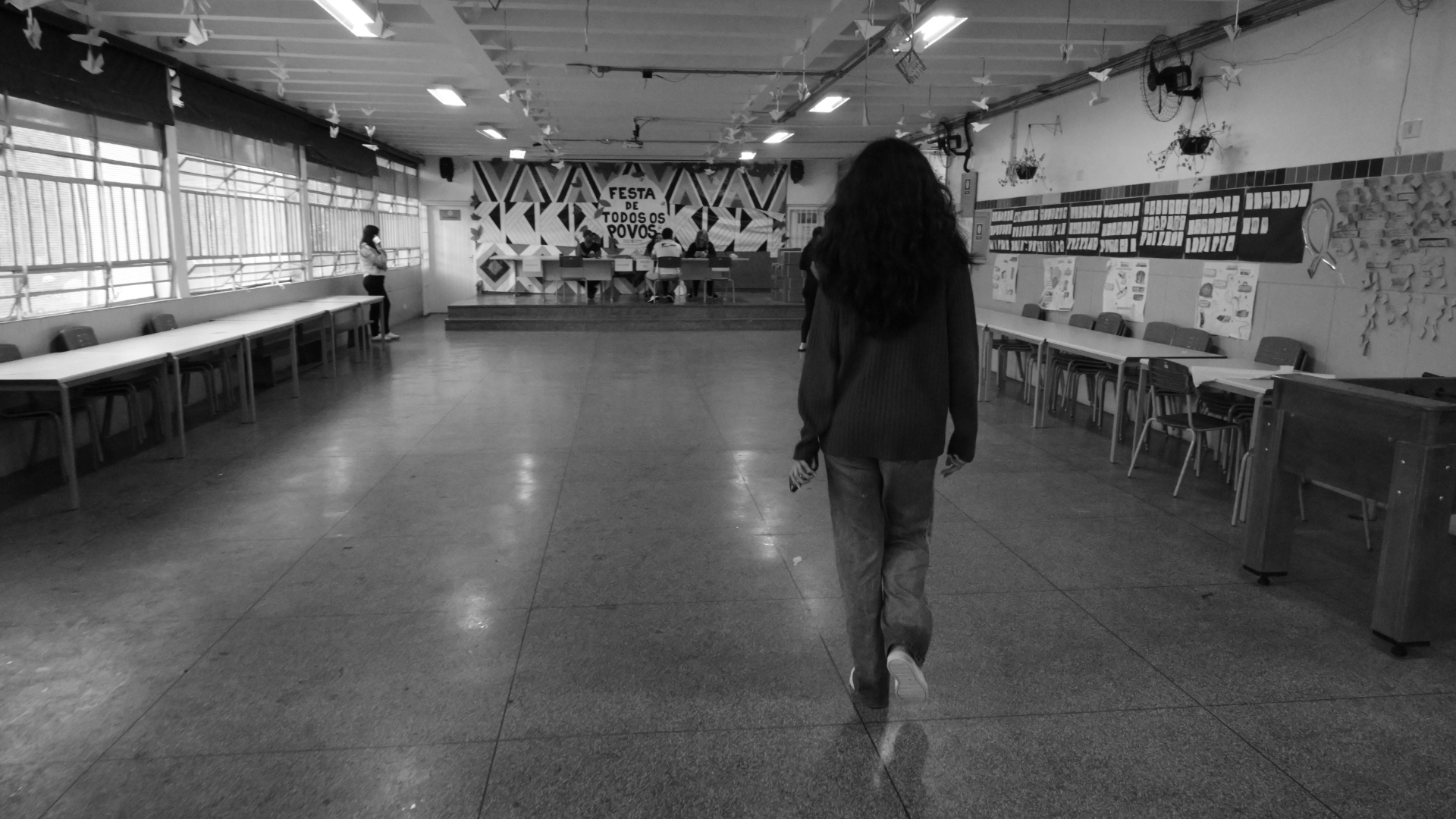
Inside, the woman proceeds through the building. The setting has the practical appearance of a public institution: corridors, chairs, signage, surfaces designed for frequent use. She is not simply arriving at a symbolic destination. There are rooms to find and procedures to complete.
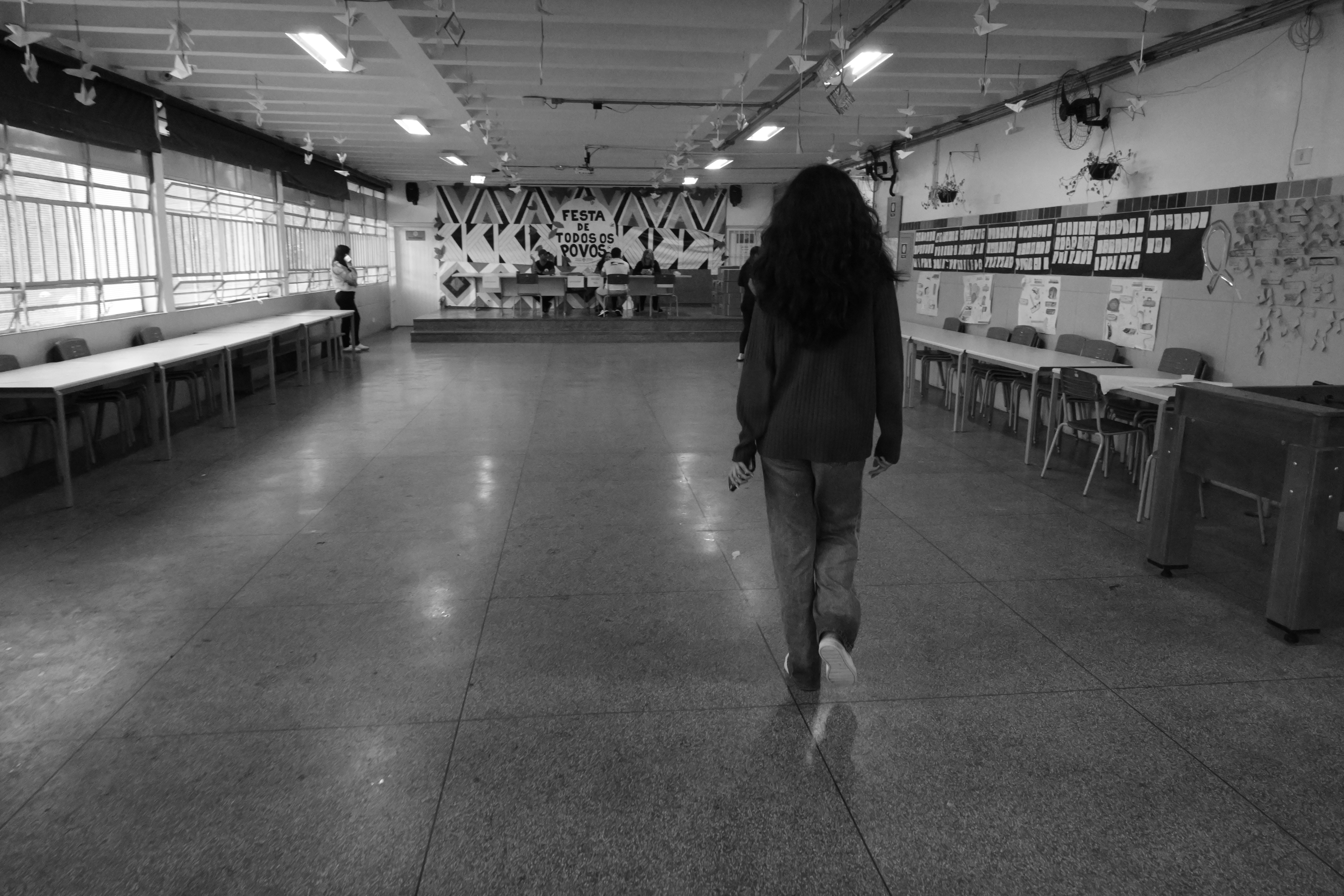
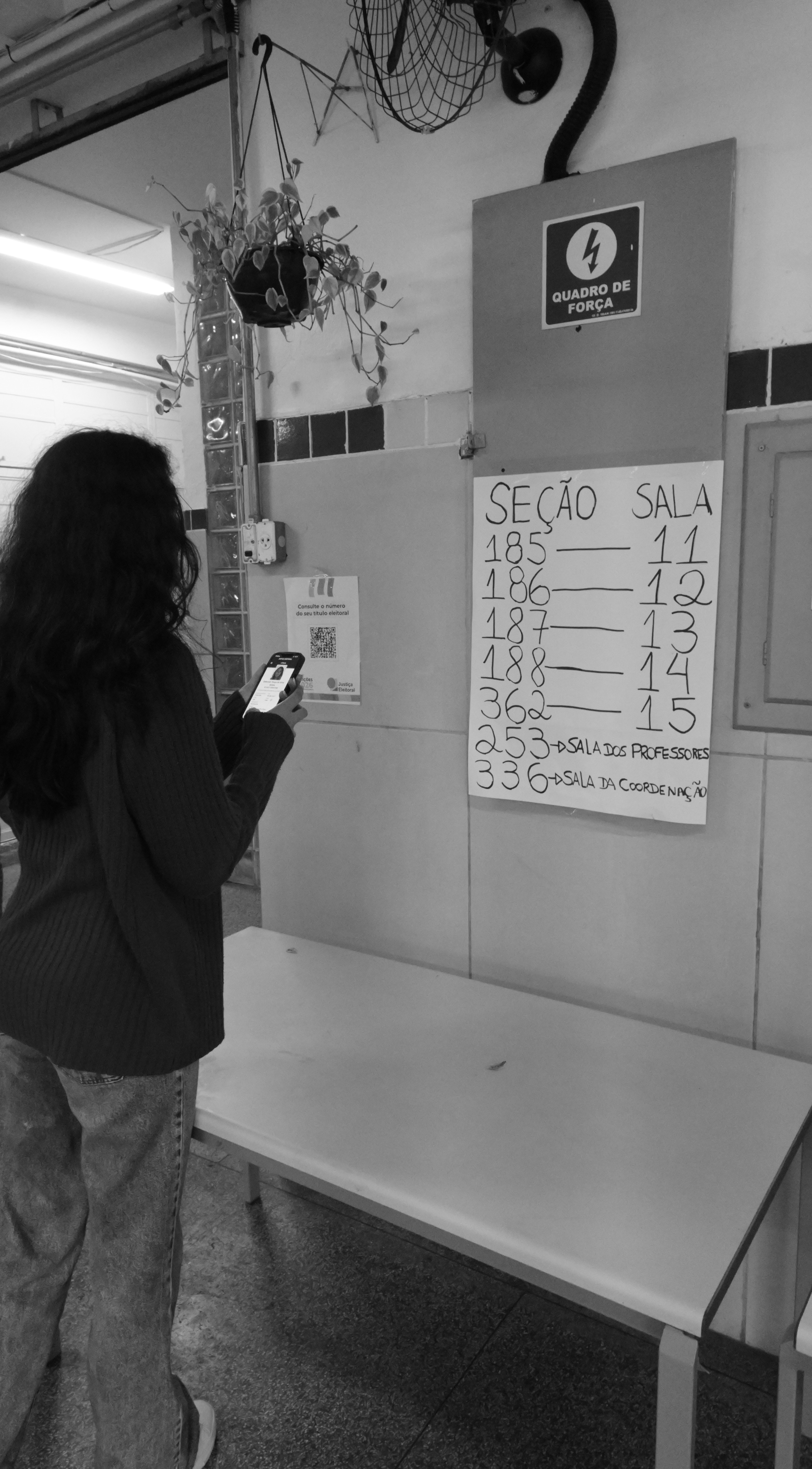
We look for the correct section. Handwritten or printed notices, room numbers and administrative signs are easy to overlook in a national account of democracy, but they are necessary at the level of one person’s experience. The right to vote has to be made usable through a system of places and instructions. The photograph of her checking where to go is therefore not an incidental picture between more important moments.
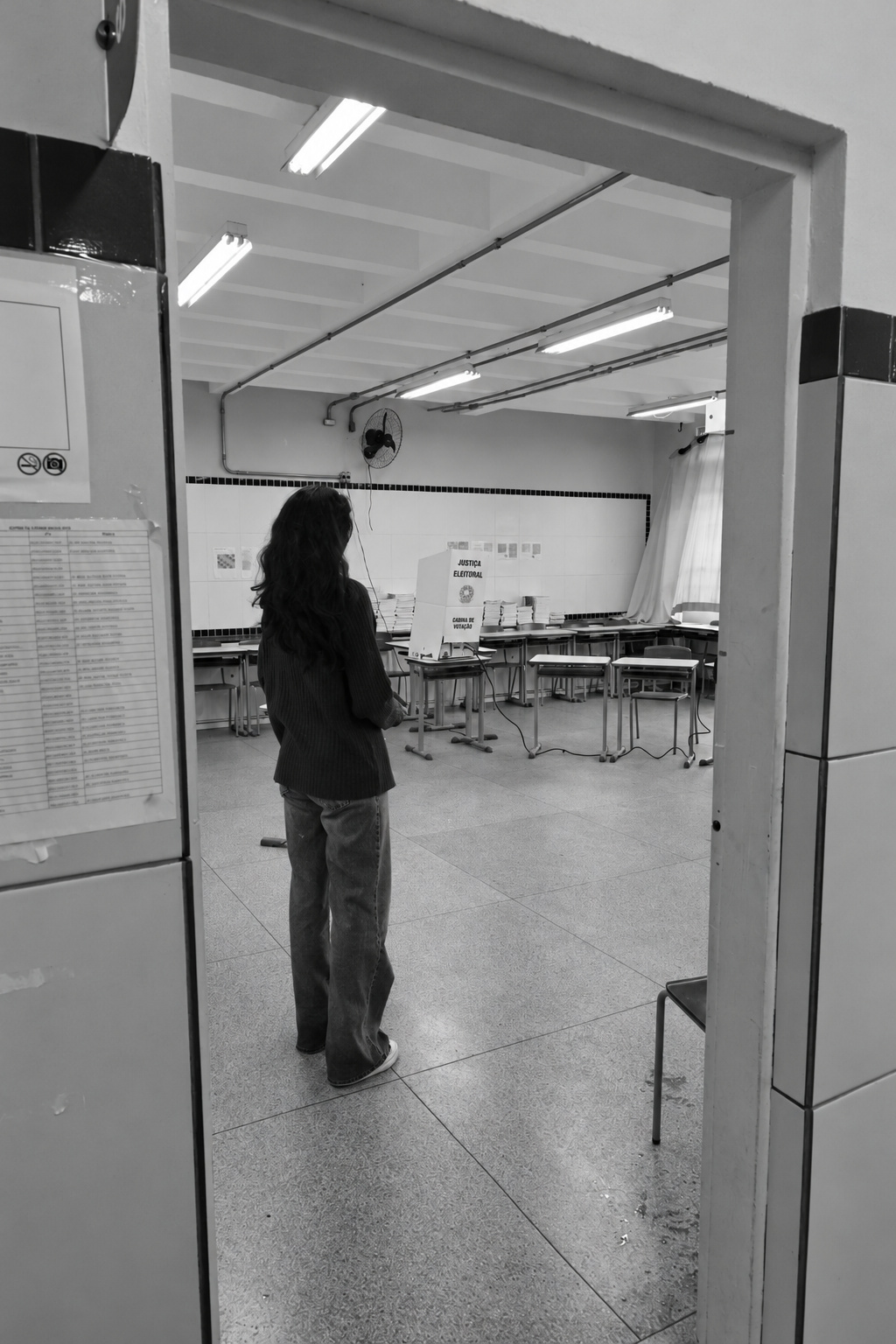
We reach the classroom used for voting. From outside the doorway I photograph the room, allowing the desks and furniture to establish its previous function before moving closer to the electoral equipment. The camera is again describing an environment as much as an event.
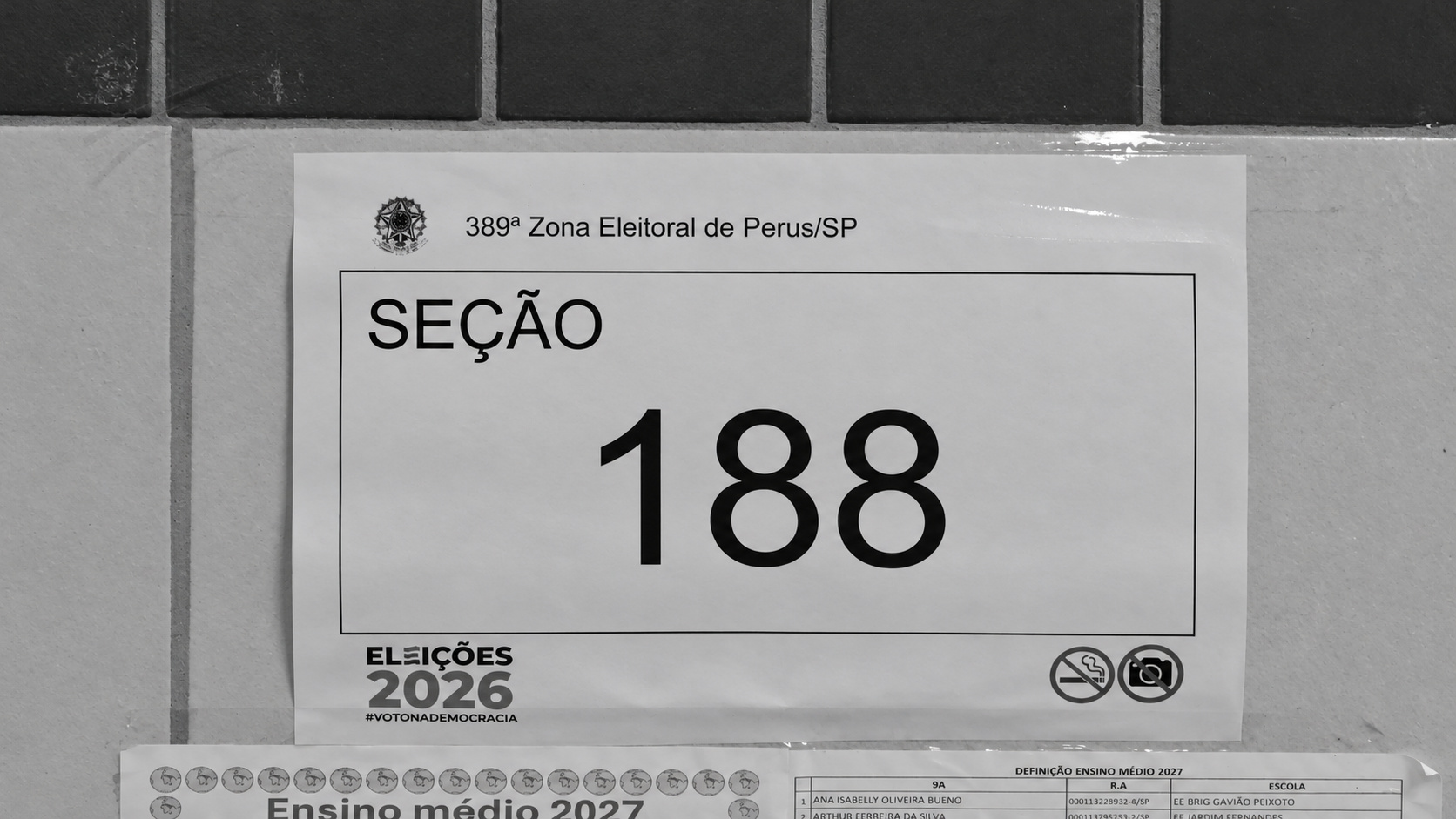
A sign identifies Section 188. This is the kind of small fact that gives a photographic story an exact location within a large public system. Millions of votes will be aggregated into results, and the particulars of a room number will not survive in the headline percentages. But for this journey, the section matters because it is the place she must find.
The Voting Room
Inside, the woman signs a form. I photograph this part of the process rather than leap directly to the voting booth. A signature is not an electoral choice; it is one of the steps required before she can make one. The presence of forms and officials is part of what participation looks like at close range.
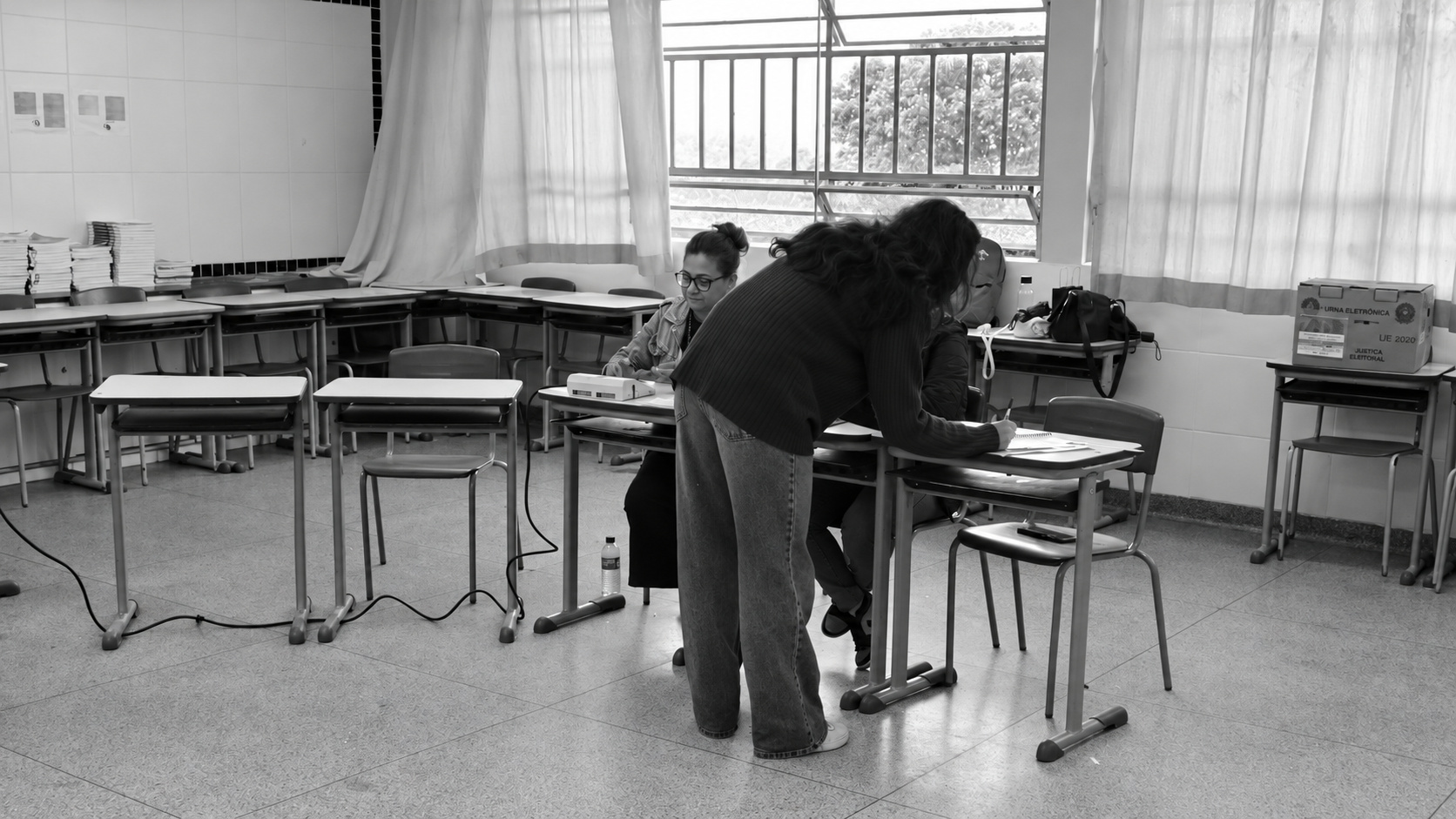
Next comes fingerprint verification. A woman working at the officials’ table assists as the voter completes the scan. The picture is about the ordinary administration of the election: equipment, people, a counter and a task being carried out. National elections depend on countless such procedures, even though public attention is directed towards the final vote totals.
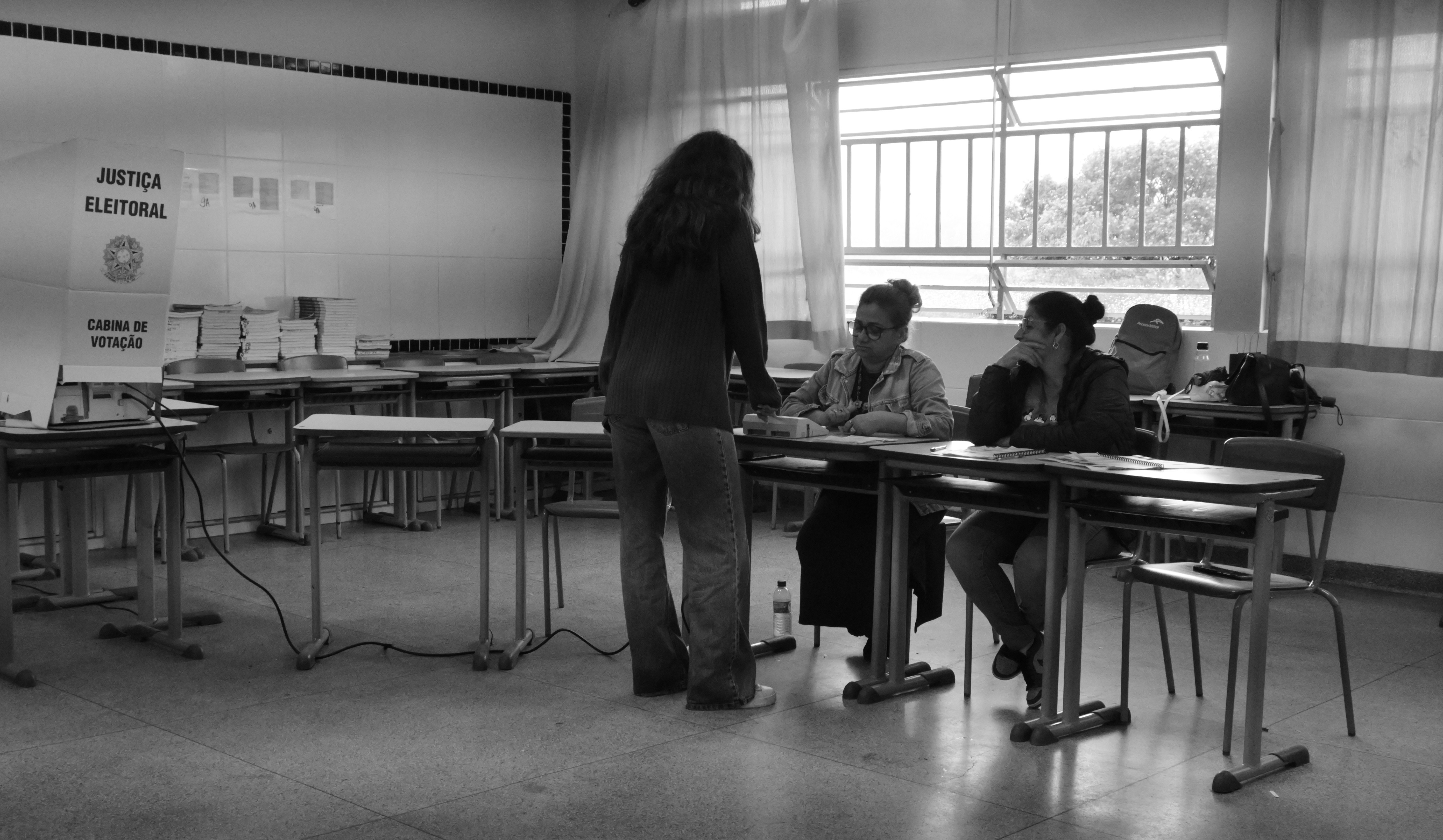
The officials, two women working in the room, welcome the presence of my camera. I did not initially ask about photographing the woman at the electronic voting machine. I assumed I could not photograph the private choice being made behind the screen, and I was careful to position myself where I could not see the display. The photograph shows the woman at the booth, partly obscured by its partition, with the voting equipment and classroom around her.
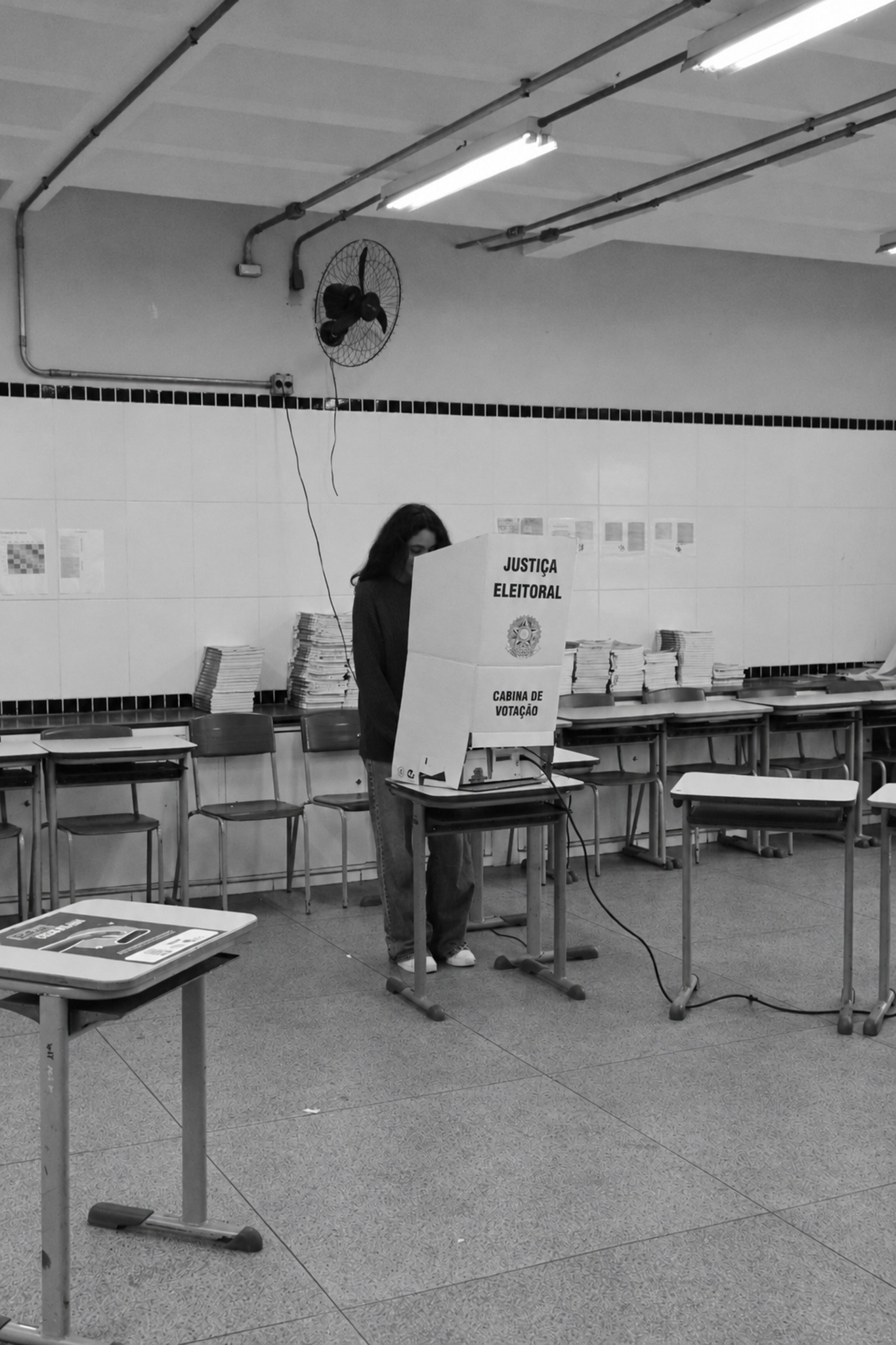
There is a limit here which I do not want to blur. The photograph does not reveal her selection, and I did not see the screen. That is what I can report from my position. Whether the presence of a camera at that point complied with the applicable electoral rules is a separate publication question, not something I can establish merely by saying the screen was hidden. The privacy of a vote and the permission to photograph are related but different matters.
Around her are empty desks, chairs, fluorescent lights, exposed electrical conduit, a wall fan and stacks of material at the back of the classroom. These ordinary physical details interest me because they place the act of voting within a room that belongs to daily life in the neighbourhood. I could emphasise the democratic significance of the machinery, but the photograph does not require every object to become a symbol.
After the digital vote, the officials suggest a photograph of her standing beside the booth. She poses and I make it. The distinction between this image and the earlier unposed photographs is clear. She is aware of the camera, the officials have participated in its making, and I have accepted the arrangement.
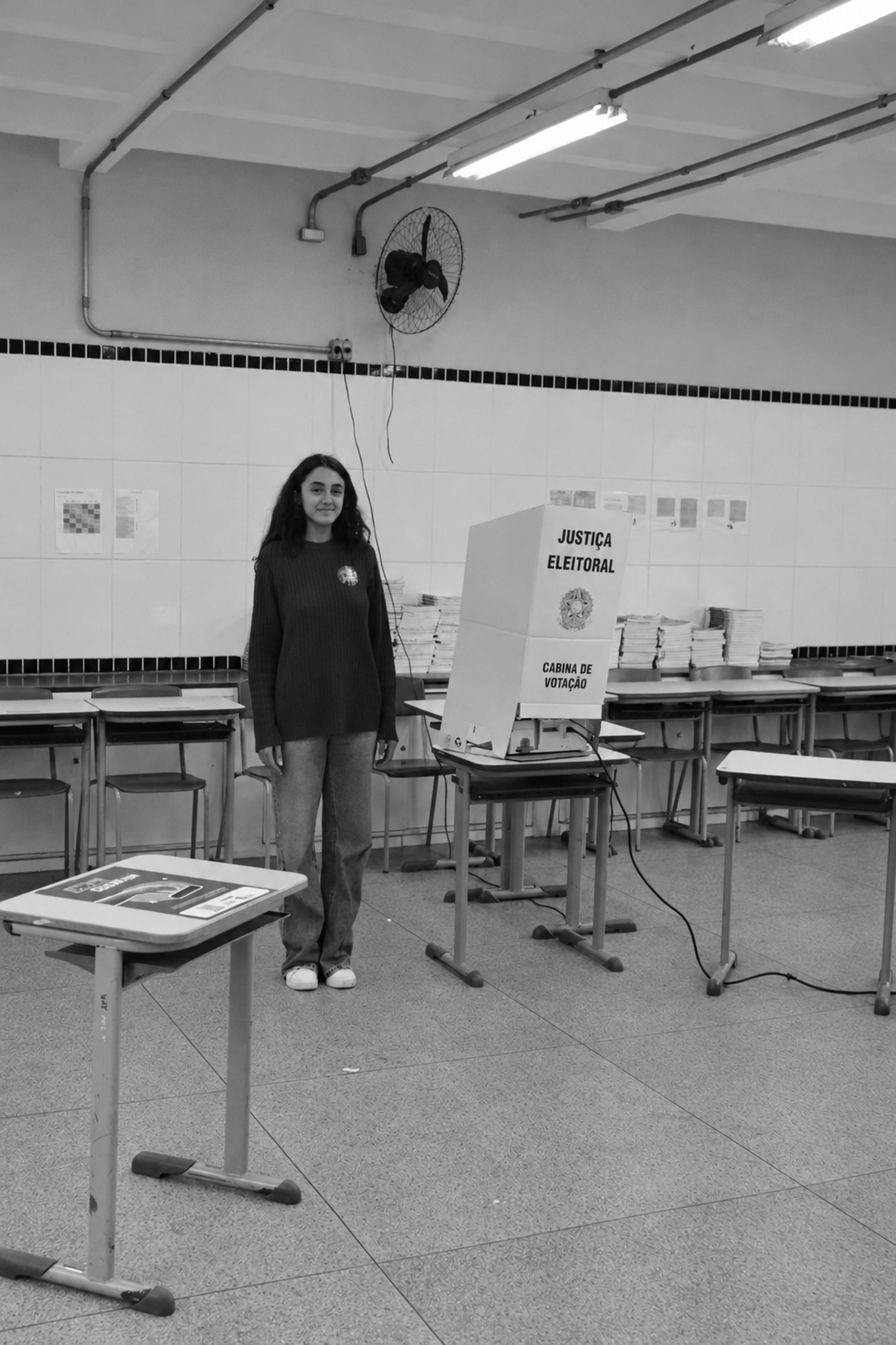
I do not see that cooperation as a flaw. A posed picture can record an actual encounter. What matters is that the viewer is not encouraged to mistake it for something else. Earlier an officer offered to stand for the camera; now the officials have suggested a final portrait. A photographic account of the day also becomes an account of how people responded to being photographed.
The Journey Home
After the last photograph we leave the polling place and travel home. The day is finished for us, though the electoral process and the counting continue elsewhere. I am back with a set of images and the memory of things that do not appear in them: the music in the Uber, the driver’s question, lasagna and rice, the family’s separate voting arrangements and the small exchanges with people who noticed my camera.
The pictures do not all carry the same kind of evidence. Some are observations made without the subjects’ participation; others were made with their cooperation. Some establish a place or procedure, while others depend upon family relationships that a viewer could not know from appearance alone. I do not think they need to be equal in visual drama to belong to the same essay. The connection is the actual progress of the day.
When I began, I was considering the difference between photographing an election through a crowd and photographing one person making her way to vote. The day has made that distinction more complicated, not less. Following one person brought me into contact with her family, two polling places, several visible political expressions and a set of encounters in which the subjects sometimes took part in making the photographs.
A national election will eventually acquire an official result. Its figures cannot tell us what played in our Uber, who made the poster at the family home or why a police officer offered to pose. Those details are too small for a national account, and some cannot be photographed at all. They were nevertheless part of the day as I experienced it.
I am not sure that these twenty-two pictures can tell us very much about what Brazil was thinking. They cannot represent every voter, and I do not want to make that claim for them. They do record something more limited: one woman’s journey through a rainy Sunday in São Paulo, the family and places around her, the procedures that brought her to a voting machine and the ordinary return home.
Whether that is a picture of democracy or simply a record of one day depends partly on what the reader expects a political photograph to do. I prefer to leave that question open. The journey is complete, and the pictures can now be examined for what they show.
One woman. One journey. One vote.