The Funeral
“He is neither amongst the living nor the dead. He is amongst the remembering.”
The clock strikes ten in the morning. The hands of time sit precisely and carefully where they ought to be. It will not be long, of course, before we will move on in a fateful manner, to the next minute which will turn into many other minutes and before we know it, even this very hour will be behind us. Even at this very moment, as we write this sentence, the hands of time rhythmically and steadily—if we are to assume that there is nothing wrong with the mechanics—march forward. The children of today, and all those who are fond of digital watches, may not fully grasp the quintessential notion of what we are getting on about, for all they see are numbers on a screen. Indeed they miss all the clicking, the ticking, and the artistry that is magnificently packed into this mechanical device by individuals possessing years of craftsmanship.
The funeral service starts. It would appear that we were getting carried away as we revelled in our admiration of the workings of time and watches, that we were almost forgetting where we are in this story. At exactly two o’clock this afternoon, not a minute before and not a minute after, the Chief of the village will interrupt the flow of the funeral proceedings and will instruct that the deceased be taken to the cemetery. “If you all check your watches, you will realise that the clock has just struck two,” he will say, "And it is time that we take him away.”
The Funeral Programme Director, who is also the eldest son of the deceased, will look at his watch and then at the copy of the programme in his hand. “But we have two more speeches,” he will say. “They will have to wait,” the Chief will reply.
“No they cannot wait, there will be no other funeral.”
“Time does not allow us.”
“But my watch shows, here, you can come and take a look, that we have two more minutes before the hour, two.”
“I cannot come to you, you come to me, I am chief of the village.”
In five, perhaps six or seven—we are not necessarily keeping count—deliberate, and almost calculated steps, The Funeral Programme Director, who is also the eldest son of the deceased, will stride over to where the Chief of the village is seated. “There is something wrong with the mechanics,” the Chief will point out.
“No there’s absolutely nothing wrong with it.”
“Did you have to put in fresh batteries at some point?”
“Yes.”
“Ah, there is your answer.”
“What do you mean?”
“In the moment that you were changing batteries, your watch was delayed and mine was still running, as with the rest of the watches here.”
The Funeral Programme Director, who is also the eldest son of the deceased, will sluggishly return to his position—of programme director—on the right-hand side of the coffin. On the way back, which will feel longer than normal, amid all the silence, we will observe, on his face, lacerations and markings of defeat from the Chief’s authoritative paws. He will make one final attempt, to lure the Chief into submission, pleading that the two speeches remaining would be made by cousins of the deceased who had travelled far. The Chief will retort, laconically, and in the final straw, “Not only time, but the laws of our village do not allow us to go any further. Ah, seeing that we have been going back and forth for a while, it is now ten minutes after the hour, two. I am chief of the village and I say we shall not discuss this any further.”
Now that we have indulged immensely in our prophetic endeavours, with the previous paragraph bearing all evidence, it is only fair that we return to the present moment. Forty-five minutes have elapsed since we left. It is important, therefore, to remind ourselves that the time is now quarter to eleven.
In front of the house, in the family yard, is a small white tent, bearing boldly on its façade, the name of the funeral home, “Of Days and Years Funeral Home.” The tent is open on all four sides, for if it was not, we would not be able to fit the coffin, the wife of the deceased, sons and daughters of the deceased, immediate relatives, distant relatives, close friends, distant friends, acquaintances, colleagues, the Chief of the village, villagers, and all others who have not earned any worth that could wheedle us into mentioning them. It may no longer be of absolute necessity for us to describe the order in which everyone is seated at this funeral, for we have already done so in the previous sentence, but we will make a few adjustments though. First, present directly beneath the tent is the coffin, the wife of the deceased, sons and daughters of the deceased, the Chief of the village and immediate family members. Second, The Funeral Programme Director, who is also the eldest son of the deceased is seated on the right-hand side of the coffin and the Chief of the village on the left-hand side, everything else is exactly as we have mentioned before.
It is at this precise moment, about five minutes before the hour eleven, that we realise that we have omitted one significant detail, what a treacherous oversight! But calling it “treacherous” might be too dramatic though, so we will just resolve to calling it a mere blunder. We will, however, grant ourselves a pardon seeing that we are enthralled by the turn of events at this honourable send-off. The detail we failed to include is that we have not made mention of the representative from Of Days and Years Funeral Home. A black suit perched on his broad shoulders, he stands aloof, observing. He will report to his boss, the Director of Of Days and Years Funeral Home at three o'clock this afternoon.
He will, however, get there five minutes later.
“You were supposed to walk in at three o’clock,” the Director will say, not looking up from the neat alignment of paperweights and invoices on his desk.
“Forgive me, sir, I got delayed at the reception. The receptionist had misplaced the log book.”
“How did it go?”
“She finally found it, sir.”
“I meant the funeral.”
“Oh. It went really well, sir…”
“Perfect!”
“...except for a row.”
“A row?”
“Yes, sir. A row.”
“What row?”
“The Chief of the village preferred that the cortège start out at exactly two o’clock—not a minute before and not a minute after—but The Funeral Programme Director, who is also the eldest son of the deceased, wanted to have two more speakers; cousins of the deceased.”
“Well, seeing that it had nothing to do with the role and services provided by Of Days and Years Funeral Home, there’s no cause for concern.”
“I suppose you’re right, sir.”
“Are people liking our services?”
“I have not heard anyone say anything in explicit terms, sir, but I have also not heard any complaints.”
“Was the tent erected in time?”
“Not quite, sir. For some unknown reason, we were missing two stakes. But ten minutes later, the tent was standing firm.”
“We cannot afford such mistakes.”
The conversation will end there.
Back at the funeral, at half past twelve, the priest of The Orthodox Church of the Millennium, where the deceased had been a devout member, is spitting metaphors. He stands in front of the coffin, facing the tent. His voice, thunderous, cuts like a knife, the words coming forth, effortlessly dismantle our cuirass, crash through our hearts in various bifurcations, and into our souls.
He speaks neither of life nor of death—at least not in plain terms, as most, if not all, of his counterparts would have done in a gathering such as this.
“You who say, we’ll continue into such a city, live there for a year or two, buy and sell, and get some good gains—how do you even know what tomorrow will bring? Do you not know that we are just like vapour?”
The Priest speaks as though these are his own words, his own proverbs, his own litanies, his own construction of the sentences, like he sat in front of the hearth in his modest house—that his house is modest, is mere speculation on our part for we do not know—took out a pencil and paper, scribbled the noble sentences and thought, “Ah, I will speak this about the deceased tomorrow.”
But we know that he has taken these words from the Holy Book. Perhaps he had gone through the exact same process of sitting in front of the hearth for an hour, two, three, or four, turning page after page of the thick volume containing centuries’ worth of texts, carefully picking verses that would best suit the occasion. Perhaps he then utilised a method of elimination, or that of the ballpark. In an alternative scenario, also seeing that he seems well-vested in the material, perhaps he knew precisely which verse to pick from the very onset. Which, if that be the case, and in direct recantation of what we said about him sitting for an hour, two, three, or four, he took much less time to prepare his talk—perhaps only twenty-five minutes—ten for reading the verse a few times, and fifteen for a rehearsal that would include projection, intonation, emphasis, and a perfect cadence.
Even though The Priest of The Orthodox Church of the Millennium took the text right out of the Holy Book and is presenting it to us and everyone gathered at the funeral as though it had come from his own mind, we have to commend him for paraphrasing it. For if he had presented the passage verbatim, it would have felt mundane and archaic, which would have easily lulled us to sleep.
The Priest is abruptly halted in the tracks of his heightened invocations twenty minutes into his talk—by the unceremonious arrival of The Second Son of the deceased. With him is his wife and five children—three boys and two girls. The children, judging from their height, size, and build, could easily be just a year or less apart.
All those present at the funeral—the wife of the deceased, other sons and daughters of the deceased, immediate relatives, distant relatives, close friends, distant friends, acquaintances, colleagues, the Chief of the village, villagers, the representative from Of Days and Years Funeral Home, and all those—as we said previously—that we have decided not to mention—in perfect harmony, raise their hands to look at their watches. It is as though, if this funeral was like an orchestra, all those present had been paying undivided attention to the most accurate of metronomes and then all in one accord, came in at the precise moment.
After this truly captivating moment that we have just witnessed—one that will surely remain in the annals of local funerary choreography—the Priest, clearly unsettled, tightens his grip on the edges of the Holy Book. A frown, barely perceptible but present, nestles upon his brow. He attempts to resume, but the moment has been broken. Something has shifted. The air is heavier, not with grief but with an oddly rippling discomfort—as though time itself, like the tent erected late, were wobbling on uneven ground.
The Second Son and his family find their way to the vacant chairs left for them beneath the tent. The eldest of his daughters stumbles slightly, regains her footing, and whispers something inaudible to her father. We do not know what it is. We will never know. What we do know, however, is that it causes The Second Son to hesitate before sitting down. For a moment, he turns his gaze to the coffin. His eyes narrow.
He leans towards his wife. “Did you see that?” he whispers.
“See what?”
“The curtain in the house just moved.”
She glances back lazily. “It’s the wind, darling.”
“There is no wind.”
“Well, perhaps someone inside closed a window.”
“But the house is empty.”
This small exchange would be dismissed as nothing if it weren’t for the fact that, just then, the priest stutters over his next phrase. He blinks rapidly, frowns, then looks towards the coffin as well.
A collective silence descends, so sudden it might as well have been scripted. Even the village dog, which had been sniffing behind the latrine, halts its restless pacing. The wind (or the non-wind) rustles a single leaf across the open yard. We all look. We do not say what we are all thinking.
The deceased might not be entirely deceased.
It is the representative from Of Days and Years Funeral Home who first moves. A slow and uncertain walk from the corner of the tent, he approaches the coffin—not with alarm, but with a bureaucratic sense of duty. He removes a small flashlight from the inner lining of his suit. The kind used to inspect pupils, to detect responsiveness. We do not know whether this is standard protocol, or whether he keeps it merely for peace of mind.
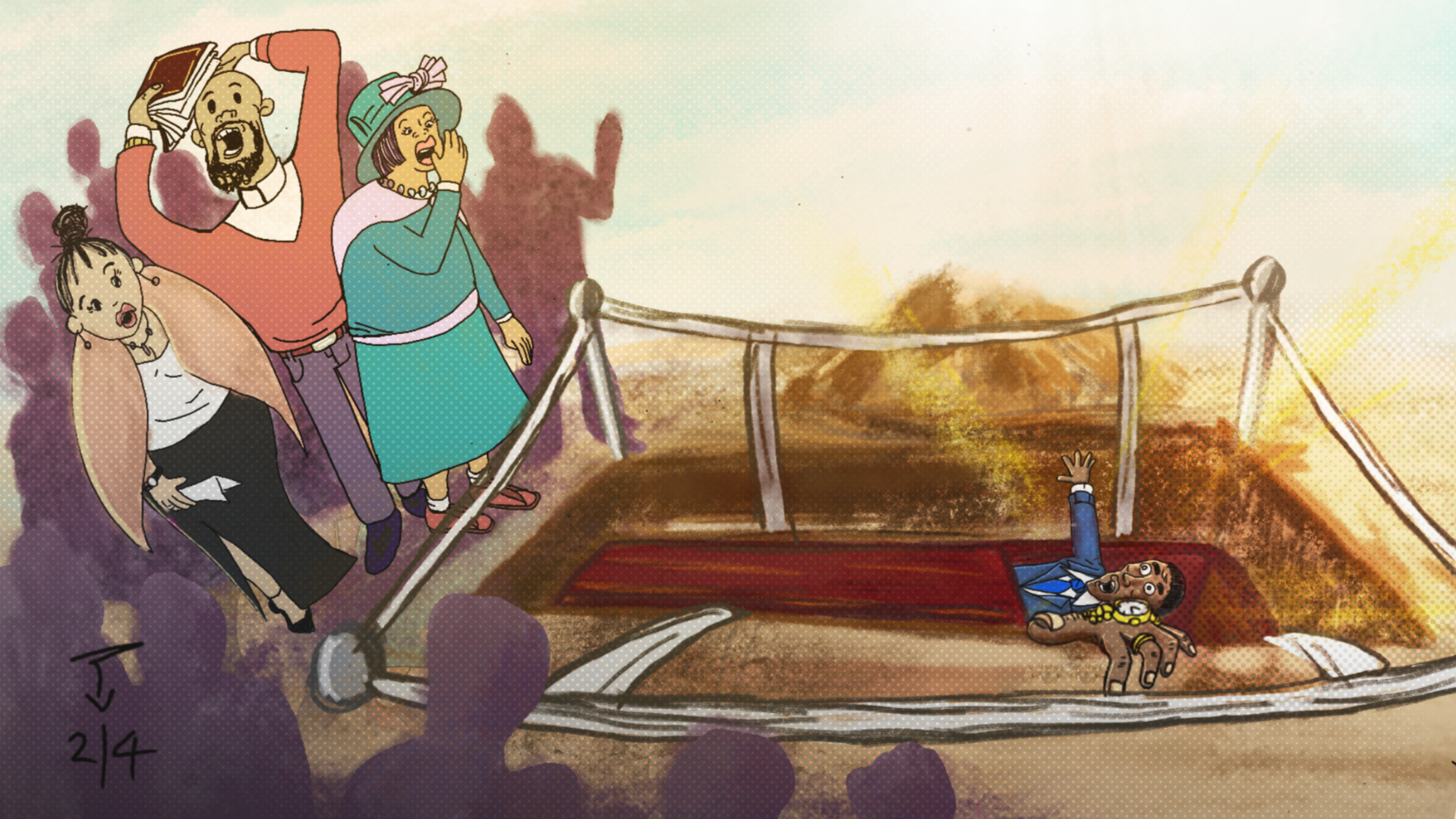
He lifts the lid, gently.
Gasps travel through the tent like a gust.
But it is not that the man inside has opened his eyes or shifted a limb. No. What startles us all is that he looks too peaceful. His skin, far from the dull pallor of death, has retained a strange, youthful glow. His mouth, though closed, seems poised to speak. His arms, crossed upon his chest, appear to rest as though in slumber rather than rigor mortis. Even his suit, pressed with too much care, betrays a sense of impersonation—as though someone else has been placed here in his stead.
The Chief of the village stands up, not in panic, but in that slow ceremonial way that only Chiefs and cats master. “Is there something to report?” he asks.
The Representative clears his throat. “Sir, the body is in good condition. Almost too good.”
“Too good?”
“Yes, sir. There are… anomalies.”
“Is he dead or not?”
“Medically, yes. Visibly… that is less certain.”
The Funeral Programme Director, who is also the eldest son of the deceased, steps forward. His voice cracks when he speaks. “We had him pronounced at the clinic. The certificate is signed and stamped.”
“Stamps do not speak truth,” says the Chief. “Only ancestors and clocks do.”
The Priest, still holding his Holy Book as if to shield himself from impending heresy, speaks at last: “There are stories, you know…”
And we do know. We know the stories.
The story of the man who rose just before burial because the soil refused him. The woman who spoke after three days in the morgue. The child who smiled in the grave, and whose casket was never found again.
But we also know what not to say aloud.
The murmurs begin. Not from mouths, but from glances—eyes darting, blinking too often, not quite looking at one another, but around. The villagers have begun to retreat into themselves, shielding their fear with ceremony, hiding their dread behind the ritual’s cold mechanics. Someone coughs. A child fidgets in her seat. The silence is brittle.
It is the grandmother of the village—the widow named ‘Masekoele—who finally speaks. She is a woman of sharp eyes and sharper memory, who claims she has outlived three husbands, five winters without firewood, and a few administrations. She rises, leaning heavily on her carved stick.
“I’ve seen this before,” she declares.
The crowd parts, not in reverence, but in trepidation.
“What do you mean, ‘Masekoele?” asks the Chief, carefully.
She fixes her gaze on the coffin. “There was a boy, long ago. Not unlike this one. Died at twenty-three. Same peaceful look. Same glow. They buried him. But for weeks afterward, his voice echoed in the kraals. Goats gave birth to calves. Cows stopped giving milk. It is not death when the soul still paces.”
No one dares to laugh.
The Priest clutches his cassock. “You speak of witchcraft.”
“I speak of unquiet things,” she says, “which you know nothing about.”
The Chief takes a breath. Then another. Then he waves at the Funeral Programme Director, who is also the eldest son of the deceased.
“Close the coffin.”
The eldest son hesitates.
“Close it!” the Chief repeats.
The Representative gently lowers the lid. The creak of the hinges is the only sound in the yard.
Then, as if summoned by the weight of silence itself, the deceased’s left eyelid twitches.
No one speaks.
No one breathes.
“I saw it,” whispers the youngest daughter.
“What did you see?” her mother asks.
“He winked at me.”
This is when everything collapses.
The tent erupts into motion. Chairs topple. Cups fall. A hat flies. The villagers flee as though smoke had begun to rise from the coffin. Some run back towards the fields, others into the house, others into themselves. Only a few remain: the Chief, the Representative, the Priest, the Funeral Programme Director, the Second Son, and the widow ‘Masekoele.
“Control yourselves!” the Chief bellows.
The Representative grips the coffin. “Sir… the lid is sealed. There is no way he could have moved.”
“And yet he did,” says ‘Masekoele. “Because you buried the man too soon.”
The Priest shakes his head. “This is beyond my training.”
“No training prepares you for the old world,” she replies. “We knew how to wait. Now you rush. Death is not punctual.”
The eldest son kneels beside the coffin.
“Father?” he whispers. “If you are there… speak.”
There is no reply.
Only the sound of the wind, which now exists.
A true breeze rustles through the dry weeds near the latrine. It hums along the hems of the cassock. It lifts a page from the programme pamphlet and carries it softly over the open yard.
The Second Son steps forward. “We must open it again.”
The Chief holds out his hand. “No. We must not disturb the order of things further.”
“But what if he’s alive?”
“Then he will return.”
That sentence hangs, trembling, in the noon air.
The Priest mutters a blessing. The Representative checks the corners of the lid, assuring everyone it is locked. ‘Masekoele begins humming an old lullaby, one meant for stubborn spirits and infants that would not sleep.
And now, we must tell you that despite all this, the cortège proceeds.
At exactly two o’clock, the Chief gives the signal.
The crowd has reassembled, though subdued and uncertain, whispering under their breath. The pallbearers lift the coffin. It feels heavier than before.
One of them swears he hears breathing.
The procession begins its slow descent towards the cemetery. The crowd moves as one long, murmuring organism—mourners shifting uneasily in their blankets, children clinging to skirts, old men walking with deliberate slowness, casting suspicious glances at the coffin.
The path to the cemetery is narrow and red-dusted, flanked by dry grass and the occasional thorn bush. Time, here, feels stretched, dilated by uncertainty. The heat presses down like a hand upon the head of every mourner. Each step is watched, counted, as if the ground itself might record who walked it and when.
At the front of the cortège, the Chief walks with his staff—ornate, heavy, unyielding. His face is unreadable. Behind him, the pallbearers shoulder the coffin with the reverence of both duty and dread. Each of them feels the weight shifting unnaturally. They do not speak of it.
Midway to the cemetery, a strange thing happens. The youngest pallbearer—barely out of his teens, strong-armed but nervy—stumbles. He swears the coffin jerked, as if nudged from within. The others catch him, steady the box. No one stops walking. But from that moment on, they hold it tighter.
At the cemetery gate, an argument brews.
“The grave is not ready,” says a boy in a dust-stained shirt, holding a half-buried spade.
“What do you mean it’s not ready?” the Representative asks.
“We hit something.”
“What sort of something?”
The boy looks towards the Chief, as if asking for permission to lie. But the Chief gestures for truth.
“A root. Or a stone. Or a box. We don’t know. The shovels bounced off it. Like it didn’t want to be uncovered.”
A pause falls over the group.
The Priest steps forward. “Let us pray.”
“No,” says ‘Masekoele. "Let us listen."
Everyone quiets. Even the birds.
Then, faintly, impossibly, from the direction of the coffin, a cough.
Not a loud cough. Not a violent cough. A dry, rustling, barely-there clearing of the throat. Like someone who has waited too long to speak.
The pallbearers freeze.
The Representative drops his clipboard.
The Chief, for the first time since morning, looks afraid.
And then, in a gesture so slow it is almost elegant, the coffin lid clicks.
No one touches it.
It simply clicks.
And opens half an inch.
The Funeral Programme Director, who is also the eldest son of the deceased, lets out a sound that is not quite a cry, not quite a gasp. He rushes to the coffin. His hands tremble as he lifts the lid.
The man inside is breathing.
His chest rises. Falls. Rises again.
He opens his eyes.
They are calm. Observing.
He looks at his sons, at the crowd, at the sky.
And says, quite softly: “What day is it?”
No one answers.
Not because they do not know, but because knowing has collapsed into irrelevance.
The Chief takes a step back, almost tripping on a stone. He clutches his staff, not for authority now, but for balance. For the very first time since the day began, he looks like a man, not a Chief.
The Funeral Programme Director, who is also the eldest son of the deceased, kneels at the edge of the coffin, his mouth dry.
“Father?”
The man inside the coffin turns his gaze upon him. “Why is everyone dressed like this? Who has died?”
A child begins to cry. A woman faints.
The Priest makes the sign of the cross, backwards.
‘Masekoele steps forward. She does not blink. “You were not meant to go yet.”
The once-deceased shifts his head slightly, then speaks again. “I dreamt I was underground. But it was not the earth. It was a room. A room with no walls.”
The Second Son, tears now tracing trails down his cheeks, stammers: “We thought you were gone. The doctor confirmed it.”
The man blinks slowly. “Perhaps I was. But not completely.”
The Representative from Of Days and Years Funeral Home looks mortified. He pulls a pen from his pocket, clicks it, uncaps it, and clicks it again. He mutters, “This has never happened. Never in the company’s history. We follow procedure. We sanitise. We certify.”
The Chief raises a hand. “Silence!”
The entire cemetery stills.
“This,” he says, “is no longer a funeral. This is a return.”
Whispers fly like startled birds through the crowd. Some fall to their knees. Some begin to leave. One man throws his watch into the grave.
The man who was to be buried sits up slowly in the coffin. His joints crack, not grotesquely, but gently, like old wood stretching after years of silence. He places a hand on the rim of the coffin and surveys the gathered mourners.
“I remember everything,” he says. “I remember the silence. The warmth. Then a voice. A child’s voice, calling me back.”
The youngest daughter, barely six, gasps. “I told him to come back.”
The crowd turns to her.
She shrinks into her mother’s skirt. “I whispered it. When everyone thought he couldn’t hear. I said, ‘Come back, grandpa. Come back.’”
‘Masekoele closes her eyes and begins to hum again. The same lullaby from earlier. Only now, it sounds less like a lullaby and more like an anthem.
The Chief, still holding his staff, bows his head.
“The laws of time have been challenged today,” he says. “Let us not pretend to understand. Let us only remember.”
And so, the man who returned is helped out of the coffin. His legs wobble. His breath is shallow. But he stands.
And the crowd, once again, moves.
But not towards the grave.
Towards home.
For there is no protocol for unburials.
The next morning, the sun rises slowly, as if unsure whether to cast light on a village that had, only the day before, defied the choreography of death. Roosters crow with hesitation. The children who had been at the funeral now watch from behind curtains. The elderly murmur in circles, sitting on overturned buckets and cracked stools, as if conjuring the language of old things that has not been spoken in decades.
The man who returned does not return to his home.
Instead, he is taken to the community hall—the neutral heart of the village, a structure usually reserved for weddings, chief’s addresses, and once, the screening of a World Cup match with borrowed electricity. He lies on a cot there, weak but alert. The Chief assigns a young boy, Khotso, to stand watch. Khotso brings him tea. Brings him bread. Stares at him with the wary reverence one reserves for prophets or outlaws.
Villagers line up to see him. Some do not come inside. They simply peek through the windows and nod solemnly. Others leave small offerings at the door: a boiled egg, a matchbox, a sprig of lekhala. Someone even places a cracked watch beneath his bed.
The Priest visits on the second day. He comes not as a man of the cloth, but as one who has heard rumours he does not believe he has the right to ignore. He sits beside the man and says nothing for a long time.
Eventually, he whispers, “What did you see?”
The man smiles faintly. “Nothing that can be translated.”
“Were you judged?”
“I was asked a question.”
“And?”
“I’m still thinking about the answer.”
The Priest does not stay long.
By the third day, the Chief holds a council. They debate whether the man is still the rightful owner of his house, his land, his name. The younger councillors argue he must undergo a cleansing. The older ones whisper that he must be taken to the mountains to ask forgiveness from the ancestors. One suggests he marry again—death having, technically, annulled his previous vows.
His wife, for her part, has not said much. She tends to the goats. She sweeps the yard. But there is a difference in her sweeping—something deliberate, ritualistic, almost as though she is sweeping away not dust, but the shadow he left behind.
On the fourth day, the man speaks to the village.
He stands outside the hall, leaning on a stick carved by Khotso’s grandfather. The villagers gather like grains in a sack.
“I am not the same man who left,” he says. “But I am also not a stranger.”
A silence falls.
“I will not ask for things to return to what they were. I will not ask for your answers. I only ask that you let me live. Again.”
And with that, he walks away.
No one stops him.
He does not go back to his old home. He walks beyond the last hut, the last footpath, towards the hills.
Some say he built a small rondavel near the stream.
Some say he disappeared into the forest.
Some say he walked into the sky.
But ‘Masekoele, when asked, only says this:
“He is neither amongst the living nor the dead. He is amongst the remembering.”
And perhaps that is where we must leave him.
Not buried. Not resurrected.
But returned.
And in the clockless space between two ticks of a second chance.